Guide · Traditional Music
What is Asturian traditional music?
Asturian traditional music is not an instrument or a museum piece: it's a system with repertoire, oral transmission and real social contexts. Here I explain it in full, and place the gaita where it actually fits within it.
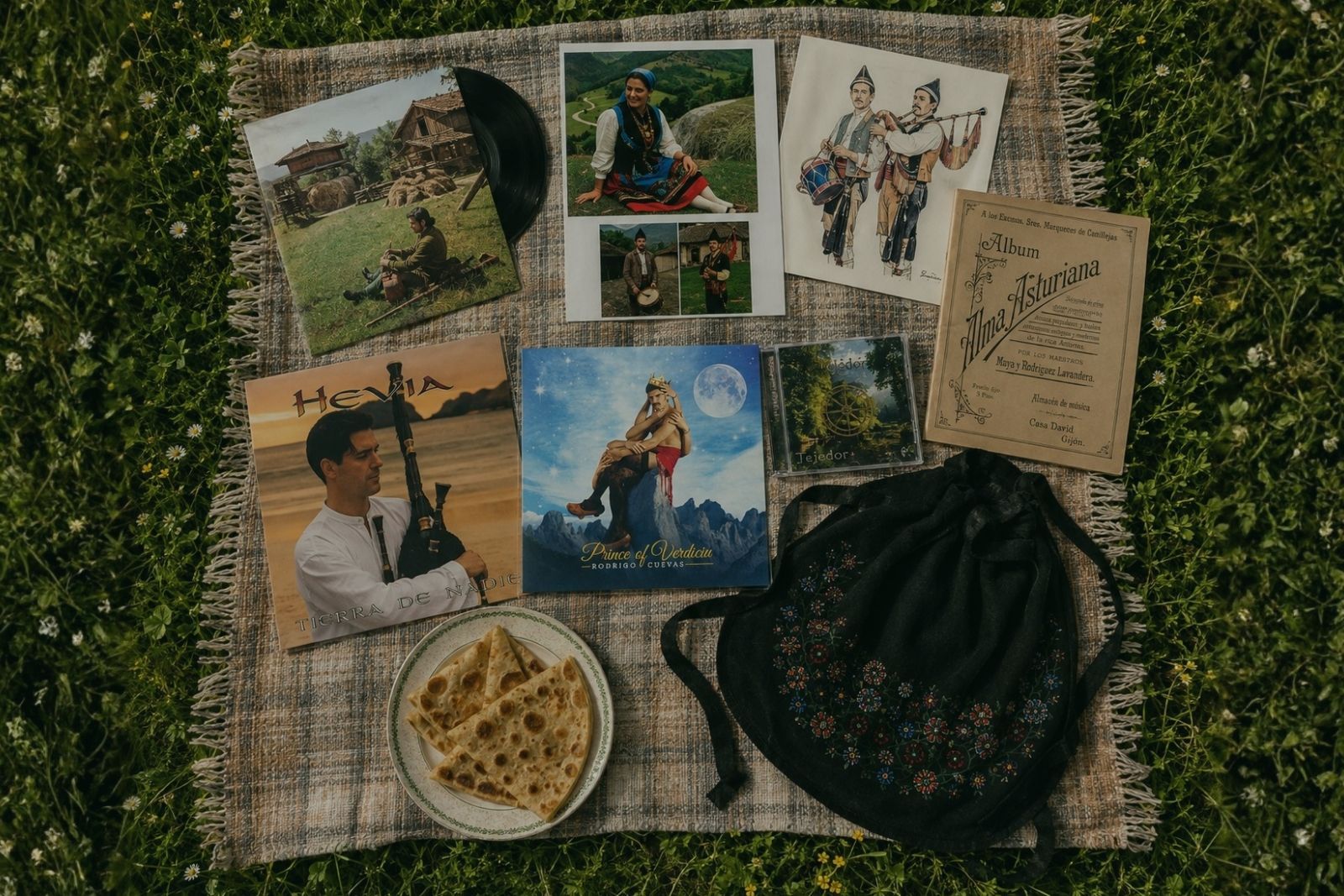
Asturian traditional music is a system, not an instrument and not a display case. It has its own repertoire —dance pieces, songs, ritual pieces—, it’s passed down by ear across generations, and it only makes sense within specific social contexts: a romería (village festival), the aguilandos of December, a farewell. The Asturian gaita is the most visible piece of that system, but only a piece. This guide explains the whole of it.
I’ve spent years playing inside that system, not just the instrument that’s most visible from outside. Let me tell you how it all fits together.
What traditional music is, and what it isn’t
This is worth stopping on, because two words used as synonyms in everyday speech aren’t the same: traditional and popular.
Traditional music is passed on by ear, generation after generation, within a community that doesn’t attribute authorship to anyone in particular. Nobody signs an alborada (dawn tune). Nobody collects royalties on a xirandilla (a lively dance tune in marked rhythm). The piece belongs to whoever plays it because whoever played it before taught it to them that way, and that chain gets lost in time. That’s what ethnomusicology understands by traditional: anonymous authorship and communal transmission, not a style or a specific period.
Popular music is a different thing, even though everyday speech mixes the two without much trouble. It can have a known author, it can be born in a recording studio, it can spread through radio or streaming. What makes it “popular” is its reach —lots of people know it, lots of people sing it— not how it was transmitted or who composed it. A song by an Asturian songwriter with mass success is Asturian popular music. That alone doesn’t make it Asturian traditional music.
The confusion comes from the fact that both live side by side and sometimes cross over: a traditional piece can become popular if it gets played a lot, and a popular piece can end up entering the tradition if a community adopts it and keeps playing it generation after generation until nobody remembers who brought it in —something close to what I describe in the case of the Bear Dance. But the origin of each stays distinct, and it’s worth not blurring them.
And there’s something more important than any academic label: traditional music doesn’t live in a catalogue or a sheet-music archive. It lives in the shared memory of the people. It isn’t an object of study that someone preserves from the outside —it’s something a community keeps making its own, week after week, festival after festival, because it decides to keep playing it. The day it stops being played, it stops being tradition and becomes history. While it’s played, it’s alive.
A system, not an instrument
When someone from outside thinks of “Asturian traditional music”, they usually think straight of the gaita. That’s understandable: it’s the most recognisable instrument, the one that sounds at the romería and the one people see in photographs —the one on the festival poster, the one the tourist films on their phone. But reducing the tradition to the gaita means keeping one piece and losing the rest of the system.
What Asturian traditional music actually is, is three things working together:
- A repertoire. Dance, song and ritual pieces with their own shape, not a jumble of loose tunes.
- A mode of transmission. By ear, from master to apprentice, generation after generation —and, increasingly, from the conservatory too.
- A set of social contexts. The music doesn’t sound in the abstract: it sounds at the festival, at the aguilandos of December, at solemn occasions and farewells, because it fulfils a specific function in each of those moments.
Take away any one of the three and it stops being the same thing. A repertoire with no social context is dead sheet music. A context with no repertoire is just background noise. And transmission without the other two doesn’t transmit anything meaningful.
The repertoire: what kinds of pieces there are
The Asturian traditional repertoire is organised by families, not by a closed catalogue of titles —and no list, this one included, exhausts what exists. Here are some examples of those families, to give a sense of the range:
- Alboradas. Dawn pieces, tied to the opening of the festival. Solemn character, open-air feel.
- Marchas procesionales. The ceremonial repertoire, linked to romerías and solemn occasions —including funerals.
- Xirandillas. Lively dance pieces, in marked rhythm.
- Muiñeiras. A dance with roots shared with the north-west of the Iberian Peninsula.
- Saltones. Loose dances of lively rhythm and marked bounce, meant for the festive circle dance more than for quiet listening.
- Xotes. The Asturian jota, a couple’s dance in well-marked rhythm, with variants of its own by district.
- Agarraos. Not a single piece but a whole family: closed-couple dances —waltz, tango, polka— that the people adapted their own way from the late nineteenth century onward, as opposed to “loose” dances such as the jota or the xiringüelu, where the dancers hold no fixed grip on each other.
- Danza prima. A sung circle dance, with no instrument, found across almost the whole of Asturies with local variants —an example that the traditional repertoire doesn’t always need the gaita to hold it up.
Alongside this there’s a wide songbook: work songs, Christmas aguilandos, tonadas (traditional Asturian songs). Not all the repertoire runs through the gaita. There’s a cappella song, there’s drum, there’s tambourine accompanying song and dance in many festive contexts where the gaita isn’t present or isn’t the lead. The gaita carries the instrumental melody when that’s its role, but the system is wider than its presence. I laid it out piece by piece, in a sensible order for listening to it or playing it, in Asturian traditional repertoire: where to start.
Oral transmission vs. the conservatory
Before a single score for the Asturian gaita existed, the repertoire already existed. For centuries, it was passed on by ear: a master played, an apprentice listened and repeated, over and over until the piece was fixed in the memory of the body, not on paper. There was no score involved in most cases —writing came later, with collectors such as Torner in the early twentieth century, and it served to document what already lived by ear, not to replace it.
That oral transmission is still alive today, in the cuadrillas (informal playing groups), in the bands, in whoever learns by listening to another gaitero play before reading a single note. But since the eighties and nineties it has lived alongside a new path: the conservatory. The Asturian gaita entered formal education, with programmes, exams and qualifications, and that changed the map of who teaches and how people learn. I describe that full institutional landscape today in Asturian gaita today: conservatory, schools, bands.
The two paths don’t compete with each other, even if they’re sometimes presented as if they did. Oral transmission gives what no score fully captures: the phrasing, the ornament, the way of breathing a phrase. The conservatory gives technical rigour, institutional continuity and the guarantee that the tradition doesn’t depend solely on one particular master having the time or the will to teach. A gaitero trained today usually goes through both.
The contexts: where this music really lives
Here’s the part most often forgotten when tradition gets discussed from outside: this music doesn’t exist to be listened to in the abstract. It exists to fulfil a function at a specific social moment. And of all those moments, there’s one that holds up the whole system, by a wide margin over the rest.
The festival and the romería
This is the context that moves the most music, that puts the most gaiteros on the street, and that sets the real calendar of the tradition: from May to September, almost every village in Asturies celebrates its own, and that celebration needs music at every stage of the day. The alborada opens the festival at dawn, when there’s still no one in the square and the gaitero plays almost for himself and for whoever’s up early. Then comes the procession, with the marcha procesional marking the pace of the parade —an image, a confraternity or local authorities, depending on the festival. And in the afternoon, when the square fills up, the dance repertoire takes over: xirandillas, saltones, xotes, agarraos, each with its own circle and its own moment.
It isn’t a one-off event, it’s a cycle that repeats village after village all summer, and it’s where most Asturian gaiteros play most of the times they play. If anyone wants to understand at a glance why Asturian traditional music is still alive and not a museum piece, a July Sunday romería is the most direct proof: there’s no stage and no ticket there, there’s people dancing because it’s their turn to dance that day, in that village, with that music.
Alongside the main romería are the smaller-scale festivals —the neighbourhood one, the parish one— which repeat the same pattern at reduced size, and which keep the tradition going in the years when the big festival can’t be held. Taken together, it’s the context that explains why gaiteros exist at all: without a romería to play, a good part of the repertoire would have nowhere to sound.
The other two contexts I go into below, the December aguilandos and the solemn and official occasions, are less frequent but no less real.
The December aguilandos
A less well-known example outside Asturies: in December, the tradition doesn’t rest on the gaita, but on song. The aguilandos are the songs proper to the Asturian Christmas season, tied to the custom of going house to house asking for the aguinaldo (a small Christmas gift) —singing in exchange for something to eat, something to drink, or a few coins. They’re oral tradition in its purest state: an anonymous songbook, collected by Torner in the early twentieth century, still sung today with no instrument needed.
The Ramu Nadal —a Christmas ornament of pagan origin, a wooden frame with green branches, candles and hanging offerings, documented in communities such as Cuñaba, Peñamellera Baxa, Cangas del Narcea or Ibias— is the festive context in which these aguilandos traditionally sound. I myself took two pieces from Torner’s songbook and reinterpreted them as Asturian carols to accompany that tradition: I tell that story in detail in Ramu Nadal: reinterpreting the Asturian Christmas tradition. It’s a good example that Asturian traditional music doesn’t live only in summer or only around the gaita: the aguilando is sung, not played with punteru (chanter) and roncón (drone).
The solemn occasions: official events and farewells
The most solemn context in the system, and the one that best proves this isn’t decorative folklore. Here it’s worth being precise: the gaita doesn’t play at official events or funerals as a matter of course, it isn’t a fixed use the way the festival is. It sounds at those moments when it’s part of a specific farewell, or when there’s someone tied to the tradition behind it —a gaitero, a family, an institution that decides that’s the sound that belongs to that moment.
There’s an institutional precedent I know from field research, from an interview with the gaitero’s own family: on 19 May 1946, on the occasion of General Franco’s visit to Oviedo —a day covered by the press of the time—, the gaiteru from Teverga, Juan Huerta, played at the event. It was a state occasion, not a popular festival, and even so the Asturian gaita was there, fulfilling a solemn function that has nothing to do with the romería.
I’ve lived that same function first-hand myself, in a farewell rather than a state occasion: I played alongside several fellow gaiteros at the funeral of journalist Aurelio Argel, in 2018 —La Nueva España covered that tribute. The marcha procesional fulfils a precise ceremonial function there: creating a suspended time in which grief can exist without anyone having to explain anything.
That association between gaita and farewell isn’t exclusive to Asturies. I discuss a parallel case, that of firefighters and police officers of Irish and Scottish descent in the US, in why bagpipes play at American funerals. They don’t share an origin with the Asturian tradition —they’re different gaitas and different peoples, from the same Atlantic arc but with no direct relation to one another—, and a good part of why we automatically associate “gaita” with “funeral” is also owed to film and television, which repeated that image until it lodged in the collective imagination. They’re two distinct traditions answering the same human need, each with its own history.
Where the gaita fits in all this
With all of the above on the table, it’s time to return to the instrument most people start from. The Asturian gaita is the central instrument of this system, but it isn’t the whole system. It’s the leading melodic voice in a good part of the instrumental repertoire —alboradas, marchas, xirandillas—, and the instrument that holds the continuous drone of the roncón under the melody. But there are pieces in the songbook, many aguilandos among them, that are sung without gaita. And there are contexts, such as the rhythmic accompaniment of a dance, where the drum carries the weight while the gaita rests.
Understanding this distinction matters because outside Asturies people tend to name the whole by the part: they say “the gaita” when what they actually mean is the whole system of Asturian traditional music. It’s a convenient shortcut, but a shortcut all the same. The gaita isn’t interchangeable with any other gaita of the Atlantic arc —I went into that comparing it with the Irish uilleann pipe and with the Galician gaita— and it isn’t interchangeable with the complete system it belongs to either.
A living system, not a closed archive
None of this is frozen. The repertoire keeps being played, recorded and composed from its roots. The clearest proof is that pieces from elsewhere —like the Bear Dance, a central European polka that arrived in Asturies in 1984— can enter the repertoire, take root and become “ours” within a few decades. A living system absorbs, it doesn’t just preserve.
That’s what sets it apart from the idea of a museum: a museum keeps pieces that no longer change. Asturian traditional music keeps changing, keeps absorbing, keeps sounding in real contexts every week of the year, because it stays alive in the people who play it and dance it, not in a display case. Understanding this —repertoire, transmission, social context, and the gaita as a central but not exclusive piece— is understanding the tradition for what it really is: a system in motion.
Bibliography
- Torner, Eduardo Martínez. Cancionero musical de la lírica popular asturiana. Centro de Estudios Históricos, 1920. The reference collection of the Asturian traditional repertoire: alboradas, xirandillas, muiñeiras and aguilandos with their context of use.
- Fernández Velasco, Alberto. La gaita asturiana: historia, técnica y repertorio. Caja de Ahorros de Asturias, 1991. A description of the instrument and the forms of the repertoire, with its ceremonial and festive function.
- Martí i Pérez, Josep. El folklorismo: uso y abuso de la tradición. Ronsel, 1996. Analyses the boundary between the traditional —oral, communal transmission, with no fixed authorship— and its transformation into a product of consumption with authorship and modern media, the basic distinction between traditional and popular that I develop in this article.
- ABC Sevilla, 19 May 1946. Digital newspaper archive with the report of General Franco’s visit to Oviedo that day.