Essay · Traditional Music
The Asturian gaita today: conservatory, schools and reference bands
How an Asturian piper trains today: from the professional and higher conservatory to the band schools, with a look at the bands and reference figures that sustain the instrument's current fabric.
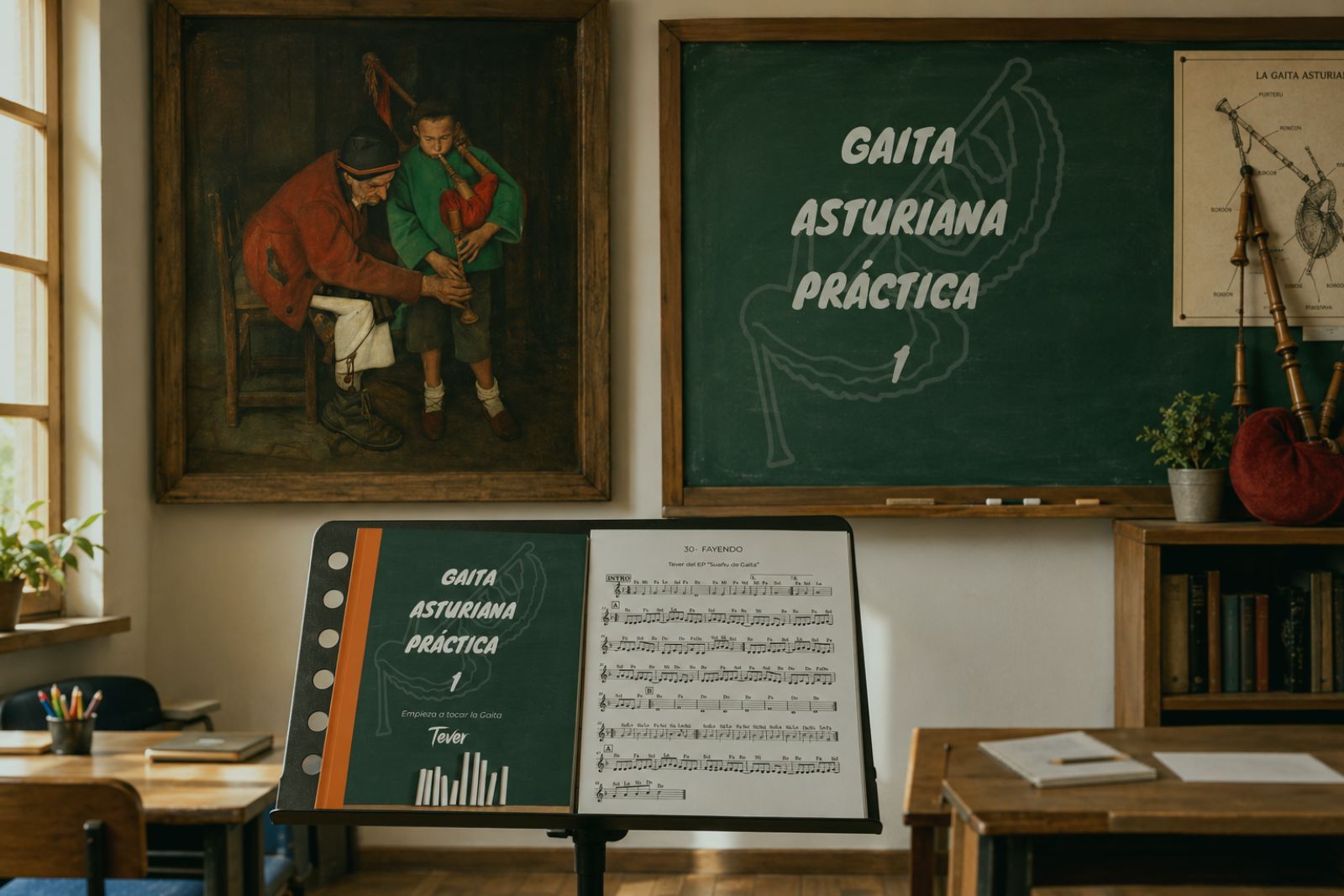
When someone asks me how you learn to play the Asturian gaita today, the answer is no longer just “with a teacher from your village, by ear”. There is still plenty of that — and it remains irreplaceable —, but for almost twenty years now the instrument has also had a formal path: conservatory, municipal schools, band schools. And around that path, a fabric of bands and ensembles is still alive, and it is actually where most Asturian pipers make our music.
This post is a survey of that picture as it stands today: what official education exists, which schools sustain the generational handover, which bands are worth knowing, and which reference figures have shaped the path so far.
The gaita entered the conservatory
The Asturian gaita has had official studies for less time than people tend to think. The Gaita subject was added to the Professional Music Conservatories of Asturias in 2006, following a curriculum drawn up by a committee of experts convened by the regional Consejería de Educación. It is taught at the Conservatorio Profesional de Música de Gijón and at the one in Oviedo.
The bigger leap came later: in the 2018-2019 academic year, the Conservatorio Superior de Música “Eduardo Martínez Torner” (CONSMUPA), in Oviedo, opened the higher-level track in “Instrumentos de la música tradicional y popular de Asturias — Gaita asturiana” (Instruments of the traditional and popular music of Asturias — Asturian gaita), part of Spain’s Enseñanzas Artísticas Superiores. This is a fact with an official date, not an impression: the call for the entrance exam was published by the Principality’s own Consejería de Educación y Cultura.
The first cohort of higher-level gaita graduates finished on 3 June 2022 — three students, trained across the track’s first full cycle. It is a small milestone in numbers but a large one symbolically: the Asturian gaita now has, for the first time in its history, an official higher-education degree equivalent to that of any other conservatory instrument.
Municipal schools and band schools
Below the conservatory sits a looser but equally important network: municipal schools and schools linked to gaita bands, which are the real point of entry for most people who start out.
The Escuela de Música de los Valles del Oso, which covers the municipalities of Proaza, Quirós, Santo Adriano and Teverga, has taught gaita since 2018, built on a local music-education base with more than thirty years behind it. It was directed by Balbino Menéndez (also director of the Banda Gaites Camín de Fierro), and I was part of it myself as an Asturian gaita teacher.
Several gaita bands were born directly out of a school of their own, not the other way round. The Banda Gaites Llacín, in Porrúa (Llanes), was founded in 1998 within the Escuela de Música Tradicional of the Asociación Cultural y Etnográfica Llacín — the band today has more than eighty members. The Banda de Gaitas La Laguna del Torollu, founded in 2005 in San Claudio (Oviedo), drew in its early days on pipers trained at the “El Pravianu” school in Viella (Siero).
Reference gaita bands
Four bands are worth knowing to understand the instrument’s current fabric, each with its own history:
| Band | Founded | Location | Distinctive trait |
|---|---|---|---|
| Real Banda de Gaitas Ciudad de Oviedo | December 1992 (“Real” title in 2017) | Oviedo | First director Guti (today Gaitero Mayor of Real Oviedo); tours across Germany, Mexico and China, collaborations with Carlos Núñez, Hevia and Melendi |
| Banda Gaites Llacín | 1998 | Porrúa (Llanes) | More than eighty members today; best band at Dublin’s “Saint Patrick” festival (2007) and best folk album at the AMAS Awards (2008) |
| La Laguna del Torollu | 5 October 2005 | San Claudio (Oviedo) | Pipers from several schools; tours across France (Nice, Albi, Béziers, Châtillon) |
| La Reina del Truébano | 1996 | Navia | New York’s Saint Patrick’s Day parade (2008) and the Guinness Trophy at the Festival Interceltique de Lorient (2008) |
Traditional bandinas: Los Gascones
Alongside the large-format gaita bands, the tradition of the bandina is still alive — a smaller ensemble, of popular roots, which proliferated across Asturies in the early 20th century. Los Gascones are a living example today: a lineup of accordion, baritone saxophone, gaita and percussion, within that same tradition of the street and festival bandina. I have not been able to confirm with a reliable source either its exact founding year or its home municipality — I am flagging this rather than inventing the data.
Three reference figures who have shaped the path
- José Ángel Hevia. The Asturian piper with the greatest international reach, winner of the first prize for solo gaita at the Festival Interceltique de Lorient (1992). Before making a living on stage, he made a living from the gaita through teaching, and in 1991 he won the first “Eduardo Martínez Torner” Ethnomusicological Research Prize from what was then the Escuela Superior de Música de Oviedo, for his work Método de Gaita Asturiana.
- José Manuel Tejedor. Winner of the Premio Nacional de Música 2008 and three McCallan awards at the Festival Interceltique de Lorient. He teaches through the Escuela Internacional de Gaita, a fully online platform (not a physical school) with three course levels.
- Flavio Rodríguez Benito. Accredited as Maestro Gaitero in 1991 by the Principality’s Consejería de Cultura. He directed the Banda Gaites Xaranzana (Oviedo) between 1988 and 1998, and is the author of two reference methods: Cien Melodías and Método de gaita asturiana (Trabe, 2014), as well as an adaptation of the gaita repertoire to the songbook of Eduardo Martínez Torner.
What this picture says about the instrument
That the Asturian gaita today has a higher conservatory track, municipal schools, active bands with international tours and published methods is not an isolated fact: it is proof that the instrument stopped depending only on oral transmission from village to village to sustain itself, and now also relies on formal infrastructure. Both things coexist, and it is out of that coexistence that the instrument’s real vitality today comes.
Bibliography
- Gobierno del Principado de Asturias, Consejería de Educación y Cultura. Convocatoria de la prueba específica de acceso a las Enseñanzas Artísticas Superiores de Música, itinerario “Instrumentos de la música tradicional y popular de Asturias — Gaita asturiana”, curso 2018-2019 (Call for the entrance exam to Higher Artistic Music Education, “Instruments of the traditional and popular music of Asturias — Asturian gaita” track, 2018-2019). Official administrative source.
- EsTuTele. «La gaita asturiana crea historia con su primera promoción de titulados superiores», 2022.
- Ayuntamiento de Oviedo. Real Banda de Gaitas Ciudad de Oviedo — ficha institucional.
- Banda Gaites Llacín. Presentación de la banda.
- Banda de Gaitas La Laguna del Torollu. Historia de la banda.
- La Voz del Trubia. «Arranca el curso de la Escuela de Música de Proaza», 2019.