Essay · Original Composition
Ramu Nadal: reinterpreting the Asturian Christmas tradition
Why I recorded «Ramu Nadal»: two pieces from Torner's songbook turned into Asturian carols, and what a twelve-candle ornament has to do with keeping a December tradition alive.
In late 2024 I released «Ramu Nadal»: a video with two pieces from Eduardo Martínez Torner’s songbook, reinterpreted as Asturian carols. It isn’t a Christmas album in the usual sense, nor a decorative piece. It’s an attempt to do something concrete: to make the Asturian gaita sound in December in its own language, not in the language of shopping-mall songs.
What the Ramu Nadal is
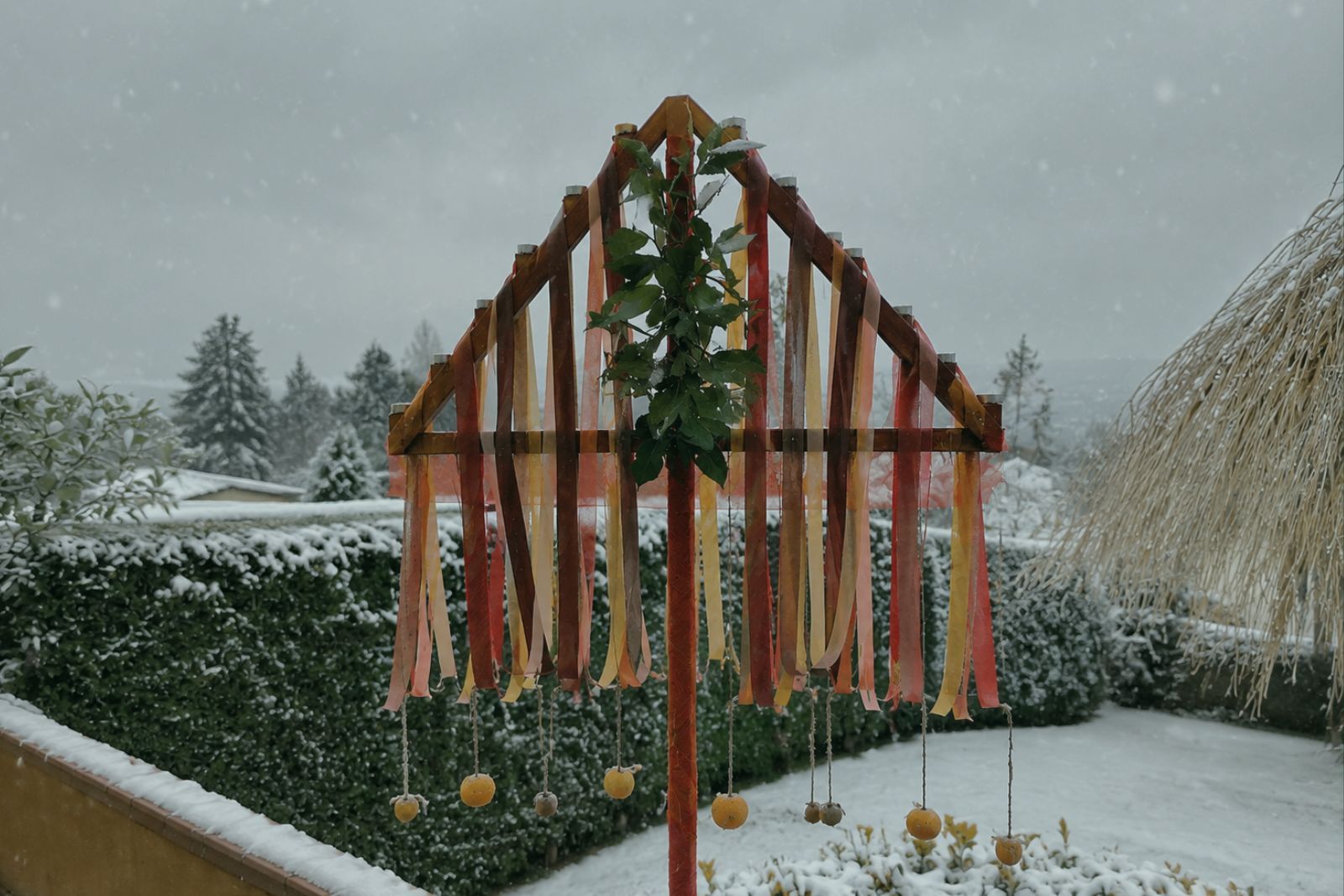
The Ramu Nadal —the Christmas branch (in Asturian, Ramu Nadal literally means the “Christmas branch”)— is an ornament of pagan origin that has been regaining presence in Asturies in recent years. The oldest documentation places it in the communities of Cuñaba, Peñamellera Baxa, Cangas del Narcea and the Ibias area.
It isn’t an exclusively Asturian tradition: in the province of León they have spent quite some time recovering this same decoration, part of a shared cultural heritage of northern Spain. The Leonese Christmas branch and the Asturian Ramu Nadal are sister variants of the same custom.
The structure is simple and precise. These are its elements:
| Element | What it is | Meaning |
|---|---|---|
| Triangular frame | A wooden structure, held up by a vertical pole on a stable base | The body of the branch |
| Green branches | Yew, fir or holly | Greenery in the dead of winter |
| Twelve candles | One for each candle on the frame | The twelve months of the year |
| Hanging offerings | Cured meats, sweets, fruit, wool tassels, embroidery | Abundance and gratitude |
| Baskets at the foot | Chestnuts or walnuts | The fruit of the land |
It isn’t an Asturianised Christmas tree. It’s something else: a ritual object with its own rules, its own aesthetics and its own vocabulary. And it has a music that goes with it.
The pieces: Torner as a starting point
I chose two pieces from Torner’s songbook —the collecting work of Eduardo Martínez Torner from the early twentieth century, a fundamental reference for Asturian traditional music—:
- «No hay tal andar» — aguilando, Torner’s songbook (collected early 20th c.)
- «Los pastores y pastoras» — aguilando, Torner’s songbook (collected early 20th c.)
Both are aguilandos: an aguilando is an Asturian Christmas carol of oral tradition, tied to the custom of asking for the Christmas box from house to house. They aren’t villancicos in the Castilian sense of the term, but rather the Asturian equivalent —songs of oral tradition collected by Torner. I reinterpreted them as Christmas pieces because they have the right festive character and fit the context of the Ramu: they’re cheerful without being trivial, Asturian without being archaeological.
The gaita doesn’t «cover» them in the popular sense of the term —it doesn’t add a synthesised bass or speed them up. It plays them in its own language: with the instrument’s own tuning, the punteru carrying the melody, the continuous drone of the roncón underneath, the phrasing of the tradition and the ornament that belongs to each note.
Why this project
I did it because the Ramu tradition strikes me as one of the most beautiful and least visible Asturian cultural objects, and because I felt there was a piece of music that could truly accompany it.
The gaita has a calendar problem: it’s almost always associated with the summer romería or with the Day of Asturies in September. That turns it into a seasonal, folkloric instrument in the worst sense: it only shows up when there’s that kind of festival. The Ramu Nadal was a chance to show that the Asturian gaita can also be the instrument of winter, of intimate celebration, of the real Asturian December.
Original composition or reinterpretation
«Ramu Nadal» sits on the border between the two, and that doesn’t strike me as a problem. It isn’t an original composition: the melodies are Torner’s (who in turn took them from oral tradition). But the treatment, the selection, the phrasing and the context are mine.
That is exactly what I think it means to work from tradition without repeating it: to take inherited materials and make something new with them that makes sense today. The same thing I describe in writing new music from tradition, though in this case the starting point is collected pieces and not invented material of my own.
Listen to it
The video is on YouTube. If you watch it in December, all the better; if you watch it in June, it works too.
→ Watch «Ramu Nadal» on YouTube
The release was covered at the time by Música Asturiana, with a review of the project and the detail of the Ramu tradition.
Bibliography
- Torner, Eduardo Martínez. Cancionero musical de la lírica popular asturiana. Centro de Estudios Históricos, 1920. The two pieces reinterpreted in this project («No hay tal andar» and «Los pastores y pastoras») come from this collection.
- Música Asturiana — reseña del lanzamiento. Coverage of the project with context on the Ramu Nadal tradition.
Frequently asked questions
-
What is the Ramu Nadal?
The Ramu Nadal —Asturian for “Christmas branch”— is an ornament of pagan origin that has been regaining presence in Asturies. It consists of a triangular wooden frame covered with branches of yew, fir or holly, with twelve candles and hanging offerings (cured meats, sweets, fruit). The oldest documentation places it in Cuñaba, Peñamellera Baxa, Cangas del Narcea and Ibias. I tell its story, with its music, in the recording.
-
What is an aguilando?
An aguilando is a typical Christmas-season song from Asturies, of oral tradition and tied to the custom of asking for the Christmas box from house to house. It’s the Asturian equivalent of the Castilian villancico. In «Ramu Nadal» I reinterpreted two aguilandos from Torner’s songbook; I explain it in the recording.
-
Which pieces does Tever reinterpret in «Ramu Nadal»?
In «Ramu Nadal», Tever reinterprets on the Asturian gaita two aguilandos from the songbook of Eduardo Martínez Torner: «No hay tal andar» and «Los pastores y pastoras». Neither was a villancico to begin with; they are songs of oral tradition collected by Torner in the early twentieth century. The project is in the recording.
-
What do the twelve candles of the Ramu Nadal mean?
The twelve candles placed on the frame of the Ramu Nadal represent the twelve months of the year. It’s one of the symbolic elements of the ornament, alongside the green branches (greenery in winter) and the hanging offerings (abundance). More on the tradition and its music in the recording.
-
Are the Asturian Ramu Nadal and the Leonese Christmas branch the same?
They aren’t independent traditions: the Asturian Ramu Nadal and the Leonese Christmas branch are sister variants of one and the same custom, part of a shared cultural heritage of northern Spain. In the province of León they have spent quite some time recovering this decoration. I place it in its context in the recording.
-
Is «Ramu Nadal» an original composition or a cover?
It’s a reinterpretation, on the border between the two. The melodies aren’t original: they are two aguilandos from Torner’s songbook (who in turn took them from oral tradition). But the selection of the pieces, the treatment, the phrasing and the context are Tever’s own. It’s working from tradition without repeating it, as I explain in writing new music from tradition.
-
Can you play the Asturian gaita at Christmas?
Yes. Although the Asturian gaita is usually associated with the summer romería or the Day of Asturies, it has its own Christmas repertoire —the aguilandos— and can perfectly well be the instrument of winter and of intimate Asturian celebration. That’s the idea behind Ramu Nadal.