Comparison · Traditional Music
Asturian gaita vs. Irish uilleann pipe: the real differences
Two gaitas that share an Atlantic root and an oral-tradition music, but whose mechanics and sound take them to different worlds. Here I tell the real differences from the experience of having played both.
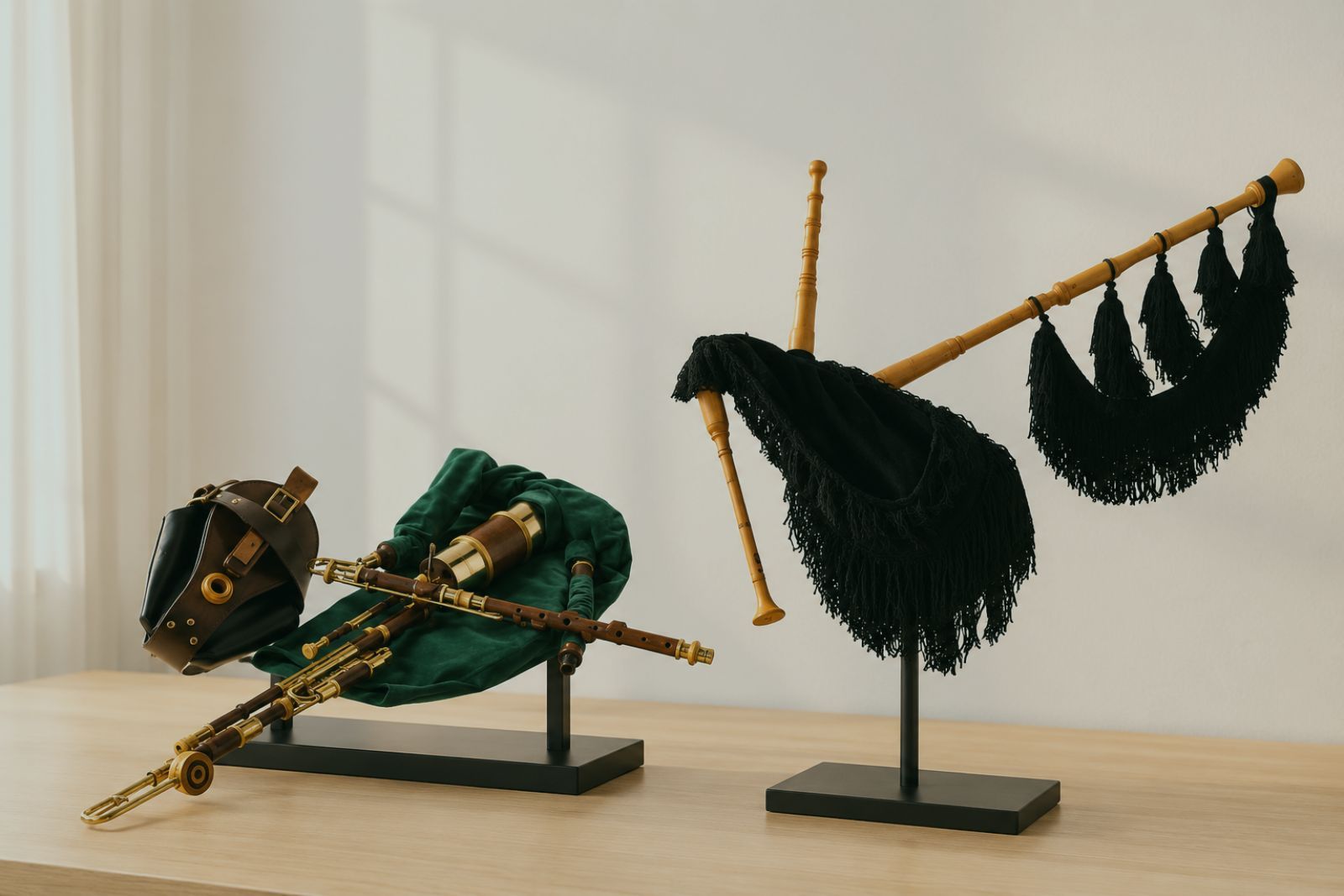
Some of my students ask me when they discover the Irish bagpipe: “if I can play the Asturian gaita, can I play the uilleann pipe?” The short answer: they share a family —both are Atlantic bagpipes with a continuous drone— but they differ on four essential points: bellows system, drones, chromatic range and sound. The resemblance runs out fairly soon.
I am not speaking from books. I have held uilleann pipes in my hands and rolled up my sleeves to try to make one sound. What follows is what I learned from that direct comparison.
Origin and organological family
Both belong to the family of European bagpipes: instruments with an air reservoir (the bag or fol), a melodic tube and one or several drones that produce a continuous sound beneath the melody. They share that basic structure with the Galician gaita, the Scottish bagpipe, the French cornemuse and other gaitas of the European Atlantic arc.
The Asturian gaita is the instrument proper to the musical tradition of Asturies, with roots documented in the northern Iberian Atlantic arc. The uilleann pipe —whose name comes from the Irish uille (“elbow”)— is the national instrument of Ireland, developed into its present form during the eighteenth and nineteenth centuries, more refined and complex than the war pipes of the Scottish family.
A common family, distinct traditions, distinct geographies, distinct evolutionary paths. That explains almost everything that follows.
The main technical differences
Bellows system
This is the most visible difference and the one that most conditions the instrument’s mechanics.
The uilleann pipe works with an elbow bellows: a piece similar to a fireplace bellows, strapped to the forearm, which the player squeezes against the body with that arm to inflate the bag. The other arm handles the payuela (reed) and the regulators. I usually describe it to those who don’t know it with a joke: it is like doing the choreography of the “birdie dance”, moving both arms at once, but with musical consequences. The player can sing while playing, and the air pressure is constant and controllable.
The Asturian gaita blows air from the mouth through the blowpipe. That limits breathing, but there is a specific organological reason that does not get mentioned enough: the Asturian payuela needs moisture to work well, and that direct contact with the mouth is what gives it that moisture. With the uilleann pipe exactly the opposite happens: the Irish reed must not have any moisture, and that is why the mechanical bellows avoids passing air through the mouth. It is not just a matter of comfort or aesthetics; it is a solution to two opposite requirements of the same component.
The pressure the player exerts with the arm on the fol and the pressure sent through the blowpipe are the two parameters the Asturian gaita player controls simultaneously and continuously.
Drones and regulators
The Asturian gaita carries a single roncón: a long tube that rests on the shoulder and produces a single continuous low note. That is the drone. The whole traditional repertoire sounds over that fixed note.
The uilleann pipe has three standard drones plus the regulators: additional keyed tubes that the player can trigger with the palm or wrist of the right hand to produce chords. It is a harmonic complexity the Asturian gaita does not have in its original design. An Irish piper who masters the regulators can accompany himself polyphonically while playing the melody. On the Asturian gaita that does not exist: the roncón is fixed, immovable, always the same note.
Range and chromaticism
The uilleann pipe was born chromatic as standard and has a range of two full octaves, which makes it an instrument of great melodic versatility from the very start of its modern form.
The Asturian gaita started from a diatonic scale —without semitones, save for occasional exceptions— and has evolved towards the modern chromatic one through the work of Asturian luthiers and gaita players. As I explain in detail in How many notes does the Asturian gaita have?, today’s punteru can cover twelve notes with the chromatic models, and the conservatories already work with that version. But that path was the fruit of a late evolution; the uilleann had it built in.
Timbre and volume
Here is the difference that stands out most on hearing, and the one that most surprises anyone comparing them for the first time.
The Asturian gaita has a considerable volume and a bright, penetrating timbre: it is conceived for the outdoors, the romería, the alborada, the parade. Its sound is designed to cut through the air and reach the far side of a square.
The uilleann pipe has a much more restrained volume and a slightly nasal timbre, more inward and melancholic: it is made for the small room, the pub session, the gathering of four people around a table. That particular timbre —intimate, with that faintly closed colour— is much prized in the world of film soundtracks. When a bagpipe sounds in a love scene or a mourning scene in an American film, you are most likely hearing a uilleann pipe, not a Scottish war pipe.
When you hear the two one after the other, the difference is immediate: one arrives from afar, the other comes in from within.
Ornamentation and fingering technique
Both gaitas use a fingering technique over open holes —without keys on the main melodic tubes— and both build their ornamentation out of rapid closings and openings of the fingers. But the grammar of the ornaments is completely different.
The uilleann pipe has its own expressive resources: the cuts (a momentary closing that breaks the note), the pops (a closing with the palm to silence the chanter briefly) and a family of ornaments specific to the Irish tradition. The Asturian gaita has its own: the picado, the fol vibrato, the slurs of Asturian root. Learning to play one well does not automatically give you the ornaments of the other.
What they have in common
The kinship is real and not merely physical.
Both are instruments of oral tradition: the repertoire was passed down for centuries from master to apprentice, by ear, without a score. Both went through declines in the twentieth century and both have led contemporary revivals —the Irish one with the folk revival of the sixties and seventies; the Asturian one with the recovery movement that started in the seventies and eighties and that today finds expression in the conservatories and in festivals such as the Gaiteros de Asturias.
Both fulfil a similar role in the cultural identity of their peoples: they are a symbol and a living instrument, not a museum piece. And both are part of that European Atlantic arc that also includes the Galician gaita —which I discuss in Asturian gaita vs. Galician gaita: the real differences— and the Scottish gaita, compared in Asturian gaita vs. Scottish gaita, as well as other instruments of the family.
The musician’s question: if you can play one, can you play the other?
This is the honest question any musician who already plays one of the two asks me.
The direct answer: at first, more or less. Properly, no.
There is partial transfer. If you have the Asturian gaita, the basic fingering over open holes is not foreign to you, and you understand the concept of a continuous drone from the inside. But the bellows system is completely different: going from blowing to managing an elbow bellows requires relearning the physical coordination from scratch. The regulators have no equivalent in your previous experience. And the ornament grammar of the Irish tradition has to be learned the way any language is learned: with time and with good teachers.
In the reverse direction —from uilleann to Asturian gaita— the most immediate challenge is the pressure of the blowpipe and managing the air through the mouth while controlling the fol with the arm. And the outdoor sound, which demands a different posture and projection.
There are musicians who master both. But they do so because they studied both, not because one handed them the other.
These are not all the differences between the two traditions, but they are the ones that matter most to the musician who stands in front of one for the first time. The bellows, the reed, the timbre: three design decisions that explain why two instruments of the same family sound and are played in such different ways.
Quick comparison
| Feature | Asturian gaita | Uilleann pipe |
|---|---|---|
| Air system | Mouth-blown (blowpipe) | Elbow bellows |
| Drones | One roncón, fixed note | Three drones + regulators with keys |
| Range | Traditional diatonic; modern chromatic | Chromatic as standard, two full octaves |
| Timbre | Bright and penetrating, for the outdoors | Nasal, indoor, for a small room |
| Position | Standing, on the move | Seated, with the bellows under the arm |
| Ornamentation | Picado, fol vibrato, slurs of Asturian root | Cuts, pops, ornaments specific to the Irish tradition |
| Traditional role | Romería, alborada, parade, Asturian funeral | Pub session, chamber music, film soundtracks |
| Technical transfer | Partial: the basic fingering helps; bellows and idiom are new | Partial: the drone concept is familiar; blowpipe and projection are new |
Bibliography
- Breathnach, Breandán. Folk Music and Dances of Ireland. Dublin: Talbot Press, 1971. — A classic reference on Irish traditional music; it devotes chapters to the origin and technique of the uilleann pipe.
- Fernández Velasco, Alberto. La gaita asturiana: historia, técnica y repertorio. Oviedo: Caja de Ahorros de Asturias, 1991. — The reference monograph on the organology of the Asturian gaita.
- Baines, Anthony. Bagpipes. Oxford: Pitt Rivers Museum, 1960. — A comparative study of European bagpipes; includes an analysis of the family of Atlantic bagpipes.
Frequently asked questions
-
How does the Asturian gaita differ from the Irish uilleann pipe?
The gaita asturiana is mouth-blown; the Irish uilleann pipe uses an elbow bellows. The Asturian one carries a single roncón with a fixed drone; the uilleann has three drones and keyed regulators for playing chords. The Asturian gaita is designed for the outdoors —bright and piercing—; the uilleann is an indoor instrument, more inward and melancholic. They share an Atlantic root and a role in the identity of their peoples, but they are two traditions with their own technique, register and grammar of ornaments. I tell the differences in detail in Asturian gaita vs. Irish uilleann pipe.
-
Are the Asturian gaita and the uilleann pipe from the same family?
Yes, they are family. The gaita asturiana and the Irish uilleann pipe belong to the same family of European bagpipes: instruments with a bag (an air reservoir), a melodic pipe and one or more drones that produce a continuous sound. That family also includes the Galician gaita, the Scottish bagpipe, the French cornemuse and other bagpipes of the European Atlantic arc. The kinship is real —melody over drone, music of oral tradition, a central role in the identity of their peoples— but the two have evolved along distinct paths: a different bellows system, different drones, a register and sonority proper to each tradition. The family is the same; the musical language each one speaks is not. In Asturian gaita vs. Irish uilleann pipe I tell the differences in detail.
-
If I play the Asturian gaita, can I learn the uilleann pipe?
There is partial transfer, but no shortcut.
What transfers: open-hole fingering won’t feel foreign to you, and you understand the concept of a continuous drone from the inside. In that sense, you don’t start from zero.
What doesn’t transfer: the elbow bellows system requires relearning the physical coordination from scratch — it’s a completely different gesture from the mouth-blowing of the gaita asturiana. The regulators have no equivalent in your prior experience. And the grammar of ornaments of the Irish tradition has to be learnt like a new language: with time and good teachers.
In the reverse direction —from uilleann pipe to gaita asturiana— the main challenge is managing the air by mouth and the outdoor projection the instrument demands. Some musicians master both, but only because they studied both.
-
What is the uilleann pipe?
The uilleann pipe is Ireland’s national instrument. Its name comes from the Irish uille (“elbow”): it is played with a bellows the musician squeezes with the arm, without blowing. It belongs to the bagpipe family —pipes with a bag and a continuous drone— just like the gaita asturiana, the Galician gaita or the Scottish bagpipe. It has three drones and additional keyed tubes called regulators that allow chords to be produced while the melody sounds. Its range covers two full chromatic octaves. It’s an indoor instrument, with a more inward and melancholic sound than the pipes designed for the outdoors. In Asturian gaita vs. Irish uilleann pipe I compare the differences with the Asturian gaita in detail.