Essay · Traditional Music
The Gaiteru Llibardón: the first Asturian gaita record
Who the Gaiteru Llibardón was, the Asturian piper who recorded the first Asturian gaita record in 1909 and took the instrument to the world's fairs of Paris, Buenos Aires and Barcelona. Why his figure still marks the path for anyone who today takes the gaita beyond Asturies.
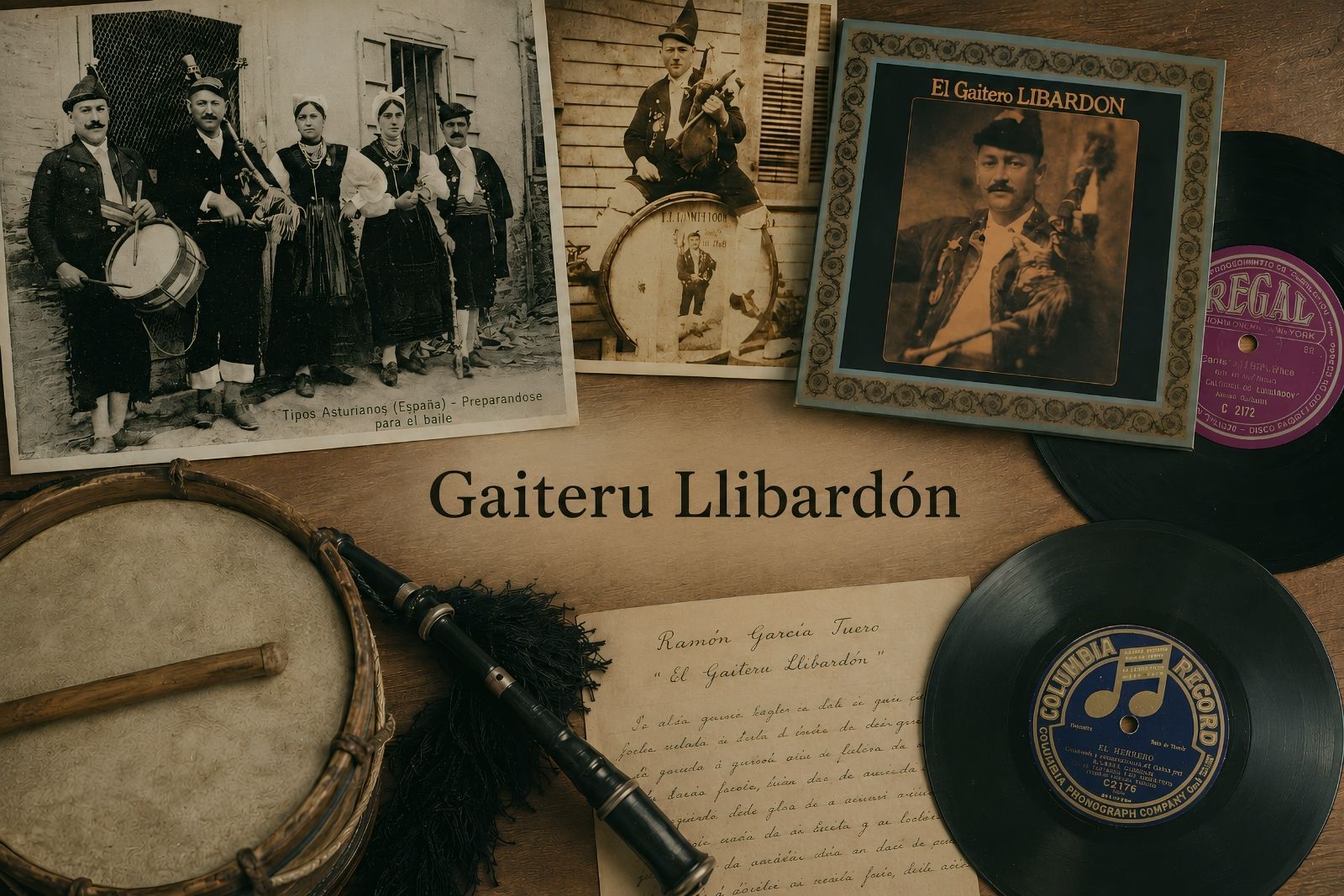
When someone searches “famous Asturian piper”, they are almost always looking for a contemporary reference. But before any international circuit existed for traditional music, there was already an Asturian piper who reached world’s fairs, toured two continents and recorded the first Asturian gaita record in history. His name was Ramón García Tuero, and everyone knew him as el Gaiteru Llibardón.
I begin with him a series about the pipers of tradition —those from before the Transición, the ones who built the road with no one ahead of them to clear the way. This is the first video in the series:
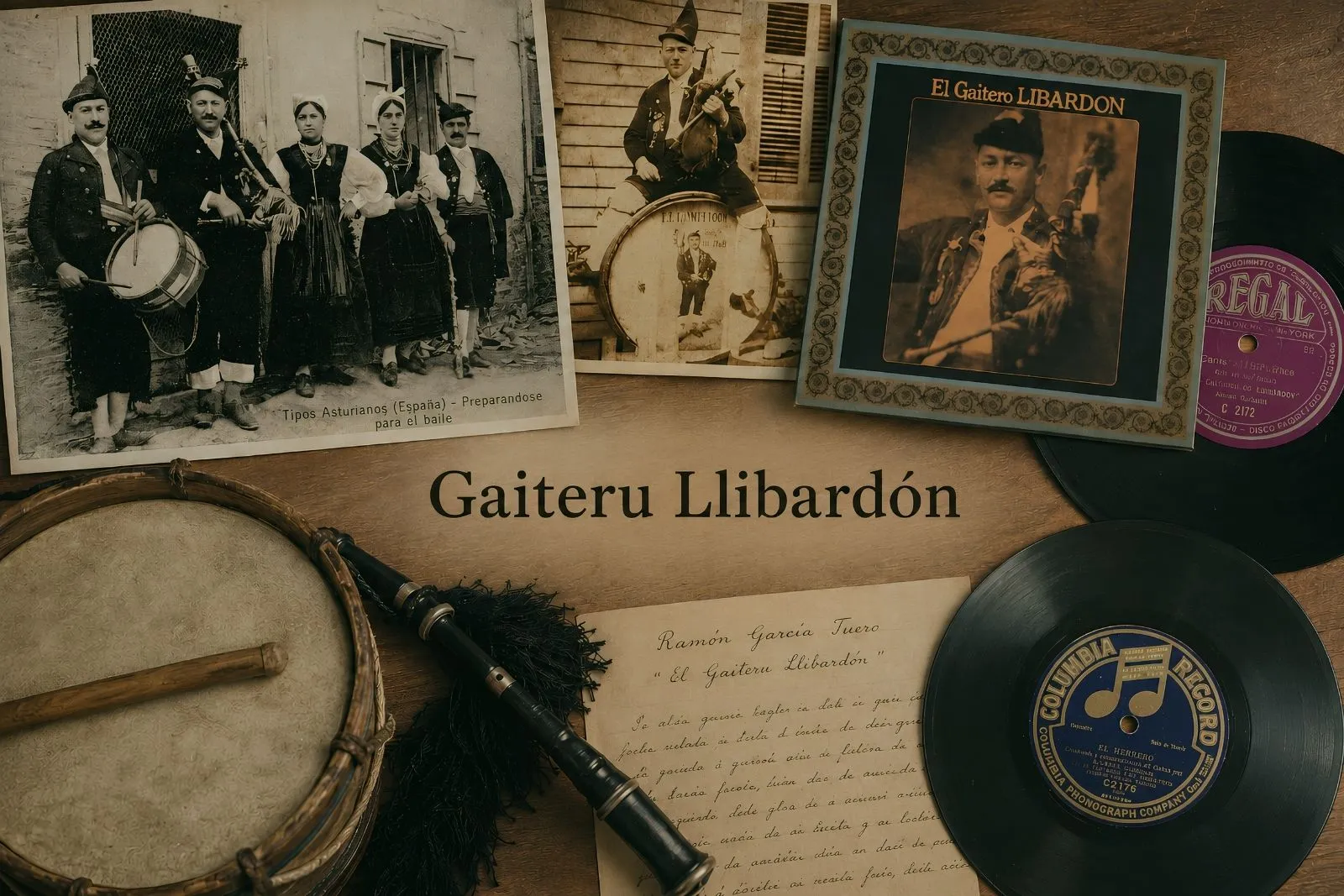
Who the Gaiteru Llibardón was
Ramón García Tuero was born on 6 February 1864 in Arroes, Villaviciosa, into a humble family of farmers. As a boy he played whistles carved from chestnut wood with a pocketknife, and his parents, seeing the talent he had, bought him a gaita in the 1870s. In 1890 he married María Caravera, from Lliberdón (Colunga), and moved to live there —that rural parish is what gave him the stage name that would make him immortal. He died on 21 October 1932, in the same village he had made his own.
His distinctive trait was not just playing well: he sang and played the gaita at the same time, something unusual then, often improvising the songs on the spot. He performed alone or accompanied by a drum, almost always played by José García, known as «el Tambor de l’Abadía». He was the lead musician of the group La Infiesta, and although the Royal Household chose José Remis Vega —the piper from Margolles, after a contest between the two best pipers in Asturies— as the king’s official piper, it was the Gaiteru Llibardón who earned the unofficial but undisputed title: the king of popular esteem.
The first Asturian gaita record
The fact that sets him apart in history is concrete and dated: in 1909 he recorded the first Asturian gaita record, becoming the first Asturian musician to access a phonographic recording. In 1911 he signed a ten-year contract in Milan, committing to record forty songs —a volume of recording work that would be demanding even today, and was then practically unheard of for a traditional Asturian instrument.
A piper of tours and world’s fairs
What the Gaiteru Llibardón did with the Asturian gaita has no easy comparison with anything before it: he took it out of Asturies and brought it to the most important international showcases of his time.
- 1889 — Paris World’s Fair, his first international trip, representing the cider house «El Horreo» from Colunga.
- 1900 — Paris World’s Fair (the one with the Eiffel Tower), where he received a jury medal of merit.
- 1907-1918 — American tours, from the southern United States to Argentina.
- 1911 — Buenos Aires International Exposition, where he signed the recording contract with a New York firm. In Cuba he came to reach a status comparable to that of tenor Enrico Caruso.
- 1929 — Barcelona and Seville expositions, his last major appearances.
In between, he toured Italy, France, Germany and England, and came to have dealings with Queen María Cristina, King Alfonso XIII and General Primo de Rivera. All of this without any professional circuit set up for Asturian traditional music: he built it himself, tour by tour.
Why he always wore the paxellu asturianu
A detail that says as much as his tours: he always presented himself in the paxellu asturianu, the traditional Asturian costume, deliberately. It was neither chance nor picturesqueness: it was a conscious decision to identify himself as an Asturian piper wherever he played, to stand out on stages where no one knew where he came from or what tradition he represented. He was building a public image as much as a repertoire.
The legacy, to this day
In 2001, the newspaper El Comercio included him among the «20 Asturians of the 20th century» in a popular contest, and that same year a gaita competition bearing his name was established in Lliberdón, dedicated especially to children and young people. In 1986, the Government of the Principality released a record with a selection of his most popular pieces. In his house in La Quintana, some of the instruments and clothes he used in his performances can still be seen.
I don’t tell this as a piece of historical trivia. Every time someone today takes the Asturian gaita outside Asturies —to an international stage, to a recording, to an audience that doesn’t know it— they are walking a path that the Gaiteru Llibardón opened with no map, more than a century earlier. I myself, as a piper who records and tours outside Asturies, follow that same path every time I play.
Video transcript
Who was the most famous piper of Asturias
There is a figure in Asturian music whose gaita transcended every border there was to cross. We’re talking about Ramón García Tuero, though he’s surely better known as the Gaiteru Llibardón. Let’s dive into the incredible story of how he carried the sound of a small corner of Spain to the whole world.
The piper from Llibardón
Ramón García Tuero, born in 1864. Although the nickname Llibardón would stay with him forever, his story actually began somewhere else, and would end up becoming much more than that of a musician. He was, without doubt, the first great cultural ambassador of Asturias.
From Arroes to the world
He was born in Arroes, in Villaviciosa, into a very humble family. But from a very young age it was already clear that his gift for music was extraordinary, a talent impossible to ignore. His skill went far beyond the gaita: he had an extremely powerful voice, and he also mastered the harmonium. And, crucially, he didn’t limit himself to playing what others had written: he composed his own music. His rise was simply meteoric. In 1889, at just 25, he was already performing at the Paris World’s Fair. And barely a decade later, in 1900, he returned to the French capital and his success was such that the jury awarded him a medal of merit.
International fame
That success in Paris was only the beginning. From there, his career exploded worldwide. On a tour of Cuba he shared the bill with the legendary tenor Enrico Caruso, the biggest opera star of the moment, and was paid exactly the same fee as him. Between 1907 and 1918, his gaita sounded all over the world: he travelled the length and breadth of Europe and crossed the Atlantic several times, carrying the music of his homeland from the United States to Argentina. With that fame, his name reached the ears of royalty: when King Alfonso XIII sought an official piper for the court, he was one of the two finalists. And although in the end he didn’t get the post, the mere fact of being considered already speaks to the immense prestige he had achieved.
Ambassador of the Asturian gaita
He became the person who dignified Asturias and carried it to the whole world. His tours, sponsored by the cider industry, joined two symbols of Asturias together. He was among the very first to record records, going as far as signing an international contract in New York, and he understood before anyone else the power radio had to spread traditional music. “The acclaimed and famous piper” — that’s how he was billed on posters and programmes of the time, and it wasn’t mere marketing: it was the pure reflection of the admiration he inspired.
An immortal legacy
His story didn’t end with his death in 1932. In 2001, almost 70 years after his death, a public vote chose him as one of the 20 Asturians of the 20th century. And his legacy has a home: in Lliberdón, the village that gave him his stage name, stands today the interpretation centre dedicated to his life and work. The story of the Gaiteru Llibardón leaves a final thought: can a single artist come to define the identity of an entire culture? His gaita didn’t just play melodies: it helped build and project Asturian identity across the whole planet.
Bibliography
- «Ramón García Tuero», Wikipedia n’asturianu: ast.wikipedia.org/wiki/Ramón_García_Tuero. Main source of biographical data, tours and recordings.
- «García Tuero, Ramón, “El Gaiteru Libardón”», Real Instituto de Estudios Asturianos — Biografías Asturias: biografiasasturias.es. Complementary source, cross-checking of data and detail on his international career.
- «El Paxellu Asturianu»: es.scribd.com/document/379226656. Source for the correct term for the traditional Asturian costume.
- «José Remis Vega», Wikipedia: es.wikipedia.org/wiki/José_Remis_Vega. Source for the episode of the choice of official piper for the Royal Household.
- «Centro de Interpretación del Gaiteru Lliberdón», Ayuntamiento de Colunga: turismocolunga.es. Source for the centre dedicated to his life and work, in the Barriu Baxu of Lliberdón (Colunga).