About
About
I play, compose and teach the Asturian gaita from Asturies. I take the instrument where it isn't expected, and I tell the road I walk alongside it.
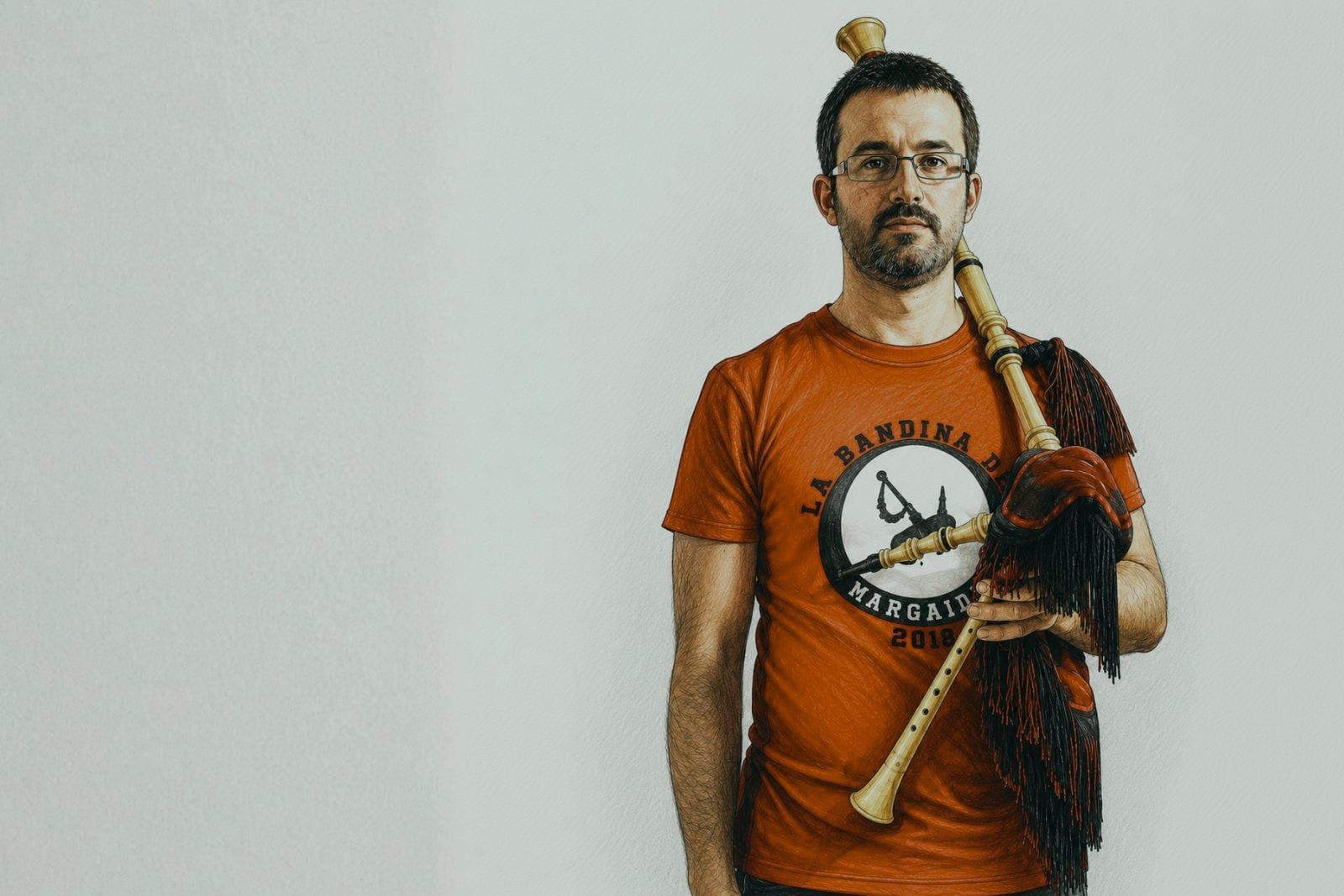
Who I am
I'm Tever Díaz García. I play the Asturian gaita, compose my own work and teach from Asturies. I started by playing the old tunes and never stopped; what changed is where I take it: from the ceremonial repertoire to the production studio, from dancing in the village square to the screens of the world that fit in the palm of your hand.
I work from a simple idea: the gaita is a living language, not a relic. I start from the deep-rooted Asturian tradition and keep an eye on the whole Atlantic family of the instrument —Galicia, Brittany, Ireland, Scotland, Cape Breton—, but not to dilute the origin: to converse from within it. This is neither world music nor folk fusion: it's the Asturian gaita in dialogue with the Atlantic arc.
The journey
My training began with playing, before I knew it was a career. In 1998, through Manolo Quirós, I came to know the roots of the Asturian gaita first-hand: one of the teachers from the first generation of master gaiteros who brought our tradition back after the hard years of the dictatorship in Asturies.
Then came the Escuela de Música de Proaza y Teverga, where I learned the craft of the Asturian gaitero alongside Balbino Menéndez and the Banda Gaites Camín de Fierro. Between 2007 and 2024 I lived first-hand what it means to share the Asturian musical tradition with my bandmates.
Another thing I always looked after was my musical training: I hold the title of Técnico de las Enseñanzas Profesionales de Música in the gaita specialty (an official Spanish professional qualification) from the Conservatorio de Oviedo. That training let me place music theory and the role the Asturian gaita plays within it. The urge to keep learning has only grown, so I go on training with Asturian professionals who help me round out my ideas: Alberto Rionda, Javi Rubio, Sam Rodríguez, among others.
My own work is where I test my ideas. In 2021 I released the EP Suañu de Gaita, six tracks that let me give shape to different concepts and, above all, put myself and what I know to the test. Each release is a small wager: seeing how far I can go with the gaita when I shift it off its centre of gravity.
Between mid-2020, in the thick of the pandemic, and the summer of 2024 I ran the CHALGA project: an instrument-making workshop using 3D printing, out of which came XIBLA, a 3D-printed learner's flute designed for getting started in traditional music. CHALGA is now closed, but it marked the direction my work follows: to create, not only to play.
Lines of work
There's a part of my work that doesn't show on stage: researching the gaita from the inside. I care about three things that are almost always treated separately, and that I treat together: the repertoire (what is played and why), the organology (how the instrument is built and what it can give) and the bridge between oral tradition and contemporary production.
I'm also a computing teacher, and that isn't a stray fact: it's the other hand I play with. The crossing point between gaita and technology is where I spend most of my time, from 3D-printed instruments to everything computing can bring to music. I'm not interested in technology because it's modern, but for what it lets me say with the gaita that couldn't be said before.
Right now I'm doing a doctorate in Automatic Music Transcription (AMT) for polyphonic music. If that work interests you, you can follow it on my research page.
I like to look at things from different angles, and music lets me work on several planes at once. This is what the field rarely does: explain the why. Tradition isn't kept by storing it in a display case, but by using it and understanding it. That's why I research in the open and tell it on the blog.
How I teach
Today my teaching lives at EMTI Fervienza, the online school for Asturian gaita and tin whistle I founded in 2026: individual and group live lessons, with no entry exams, for anyone who wants to learn without living near a conservatory or a music school. I bring the Asturian tradition to wherever you are.
I teach because I learned from people who took the time to explain things to me, not just to play them in front of me. That teaching, for those picking up the gaita for the first time and for those who already play and want to go further, lives at EMTI Fervienza.
But the lesson isn't the only place where I teach. I write on the blog and keep a glossary of the craft's terms: guides, tutorials, comparisons and, above all, the why of things. What I know, I tell. In a field that piles up achievements and rarely explains, I'd rather be the teacher who publishes.