Essay · Traditional Music
The evolution of our sound: how the Asturian bagpipe learned to play with the world
The bagpipe you hear today in public squares and on stage is not the same instrument as a hundred years ago. It is a tempered bagpipe. The story of how that change happened, why it was necessary and who made it possible.
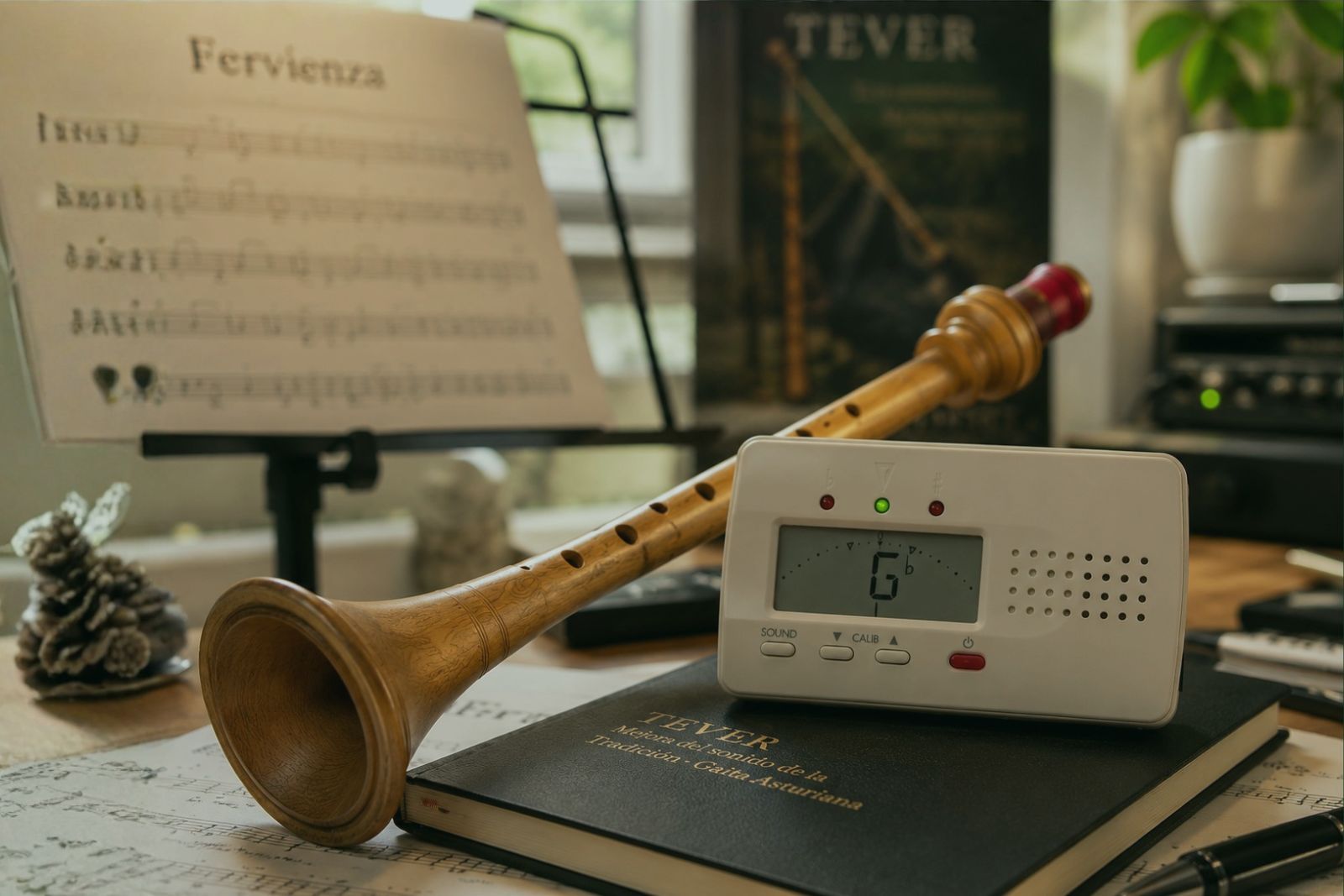
The Asturian gaita you hear today in public squares — the one played by bands, amateurs and professionals on stage — is a tempered instrument. Alberto Fernández Velasco made that possible during the eighties and nineties, when he brought acoustic engineering criteria to bear on an instrument that had spent centuries tuning itself only against itself.
To understand why that change was so profound, you need to step down from the theoretical pedestal and look toward the meadow: toward the moment we stopped playing alone.
The solitary past: tuning only against the root
Traditionally, the gaita asturiana was an untempered instrument. That does not mean it was poorly made; it means it had one single, very specific goal: to sound perfect against its own roncón.
The craftsman built the punteru following natural physical proportions so that the notes blended with that continuous C (or B-flat) of the drone. It was a private dialogue between the player and the instrument. It worked beautifully for the old solo repertoire, but it had a very clear invisible boundary: the gaita asturiana was isolated from the rest of the musical map. If you tried to bring together several bagpipes from different makers, or add a piano or a guitar into the equation, the result was a full-scale battle of frequencies.
Equal temperament: the language of shared celebration
My work as a gaitero is rooted in emotion, in building community. I am hired so that neighbours can celebrate their festivals together, to lift the spirit of a village on its big day. And for music to be a genuine collective celebration, it needs to combine forces.
That is where equal temperament comes in. This musical system — the same one used by a piano or a modern guitar — divides the octave into twelve exactly equal semitones. It is a kind of universal rulebook that standardises the distances between notes.
When the gaita asturiana chose to play by these rules and adopt equal temperament, everything changed:
- It made the birth of bandas de gaites possible: getting twenty or thirty chanters to sound in unison as a single voice, without sounding like a swarm of wasps, is mathematically impossible without temperament.
- It opened the doors to other instruments: it gave us the passport to play with orchestras, folk groups, pianos at solemn ceremonies or guitars at a festival.
The decisive link: Alberto Fernández Velasco
This transition did not happen by magic. It had names and surnames, and the most important of all was craftsman and piper Alberto Fernández Velasco. He was the great forerunner who steered the history of the gaita asturiana towards modernisation.
| Stage | Period | What happened |
|---|---|---|
| The isolated traditional bagpipe | Before the 1980s | Bagpipes with natural tuning. Each craftsman worked from his own template. The instrument tuned only against its own drone; performance in large groups was unfeasible. |
| The revolution in Velasco’s workshop | 1980s and 1990s | Alberto Fernández Velasco applied scientific and acoustic-engineering criteria to the turning process. He redesigned the punteru to suit equal temperament, achieving a stability and standardisation never seen before. |
| The era of bagpipe bands | 21st century | Thanks to Velasco’s legacy, Asturian folk music experienced an unprecedented boom. Bands multiplied and the gaita asturiana reached the technical maturity needed to tour the world. |
Velasco did not strip the soul from the instrument; on the contrary, he perfected it and saved it from isolation. He managed to keep the gaita asturiana’s strength and Asturian character while placing it within the frequencies of the contemporary world.
Working from the heritage
Today, when I step onto a stage, when I record in the studio or when we accompany a neighbour on their village festival day, I do so with an instrument tuned to the millimetre.
Composing from the root no longer means closing the door to outside mathematics. It means understanding that, thanks to the work of masters like Velasco, the gaita asturiana can carry its emotional weight — from the euphoria of the alborada to the solemnity of a farewell at a graveside — to any corner of the map.
If you want to see how that emotional weight translates into original composition, I write about it in Composing from the root: when music is the family name.
Bibliography
- «Fallece Alberto Fernández Velasco, gran maestro de la gaita asturiana». La Nueva España, 30 de agosto de 2011.
- «El folclore llora la muerte de Velasco». El Comercio, 30 de agosto de 2011.
- «Alberto volcó la historia de la gaita asturiana hacia la perfeición del instrumentu». Asturies.com.
Frequently asked questions
-
When did Asturian gaita bands start to multiply?
Asturian gaita bands multiplied mainly from the late 1980s and through the 1990s, driven by the standardization of equal temperament on the punteru — work led by craftsman and gaitero Alberto Fernández Velasco.
Before that, gathering twenty or thirty gaitas from different workshops and getting them to play in unison was mathematically impossible: each instrument tuned against its own roncón, which meant no two were truly in the same system. Equal temperament gave them a shared reference, and the band format became viable.
I tell the full story of that shift in The evolution of gaita asturiana tuning.
-
How does natural tuning differ from equal temperament on the Asturian gaita?
Natural (untempered) tuning is what the gaita asturiana had before modernization: the craftsman built the punteru so that its notes blended with the roncón of that specific instrument. It was perfect for solo playing — the internal coherence of that one gaita was pure — but it made playing alongside other gaitas or melodic instruments like piano or guitar essentially impossible. Every instrument lived in its own slightly different tonal world.
Equal temperament sacrifices that internal purity in exchange for a universal system: twelve exactly equal semitones, the same grid used by a piano or a guitar. Twenty gaitas from different workshops can now sound in unison. The gaita opened up to the contemporary musical world without losing its Asturian character.
I go into the full history of this shift in The evolution of gaita asturiana tuning.
-
What is equal temperament and why does it matter for the Asturian gaita?
Equal temperament divides the octave into twelve exactly equal semitones — the same system used by a piano, a modern guitar, or any instrument that plays with others in contemporary music.
For the gaita asturiana it was decisive. Before equal temperament, each instrument tuned against its own roncón: perfect for solo playing, but impossible when playing with other gaitas or melodic instruments. Every workshop produced instruments in slightly different tonal worlds that couldn’t coexist cleanly.
With equal temperament, the gaita shares a common musical language with every other instrument in the world. That’s what makes gaita bands possible, and what allows playing alongside an orchestra, a folk ensemble, or a studio session.
It didn’t take the soul out of the instrument. It opened it up.
I trace the full history in The evolution of gaita asturiana tuning.
-
Who was Alberto Fernández Velasco and what did he change in the Asturian gaita?
Alberto Fernández Velasco was the craftsman and gaitero who drove the technical modernisation of the Asturian gaita in the 1980s and 90s. He applied acoustic engineering criteria to the turning of the punteru: he redesigned its proportions to adapt it to equal temperament, achieving a stability and standardisation that had not existed before. He did not take the soul out of the instrument; on the contrary, he perfected it so that it could sound alongside the contemporary world without losing its Asturian character. He died in 2011.