Essay · Traditional Music
Why bagpipes play at American funerals
Bagpipes at American funerals were not born of an aesthetic decision. They were born of the Great Famine, of the only jobs left to Irish and Scottish immigrants, and of a 1972 record that burned the image into the collective unconscious.
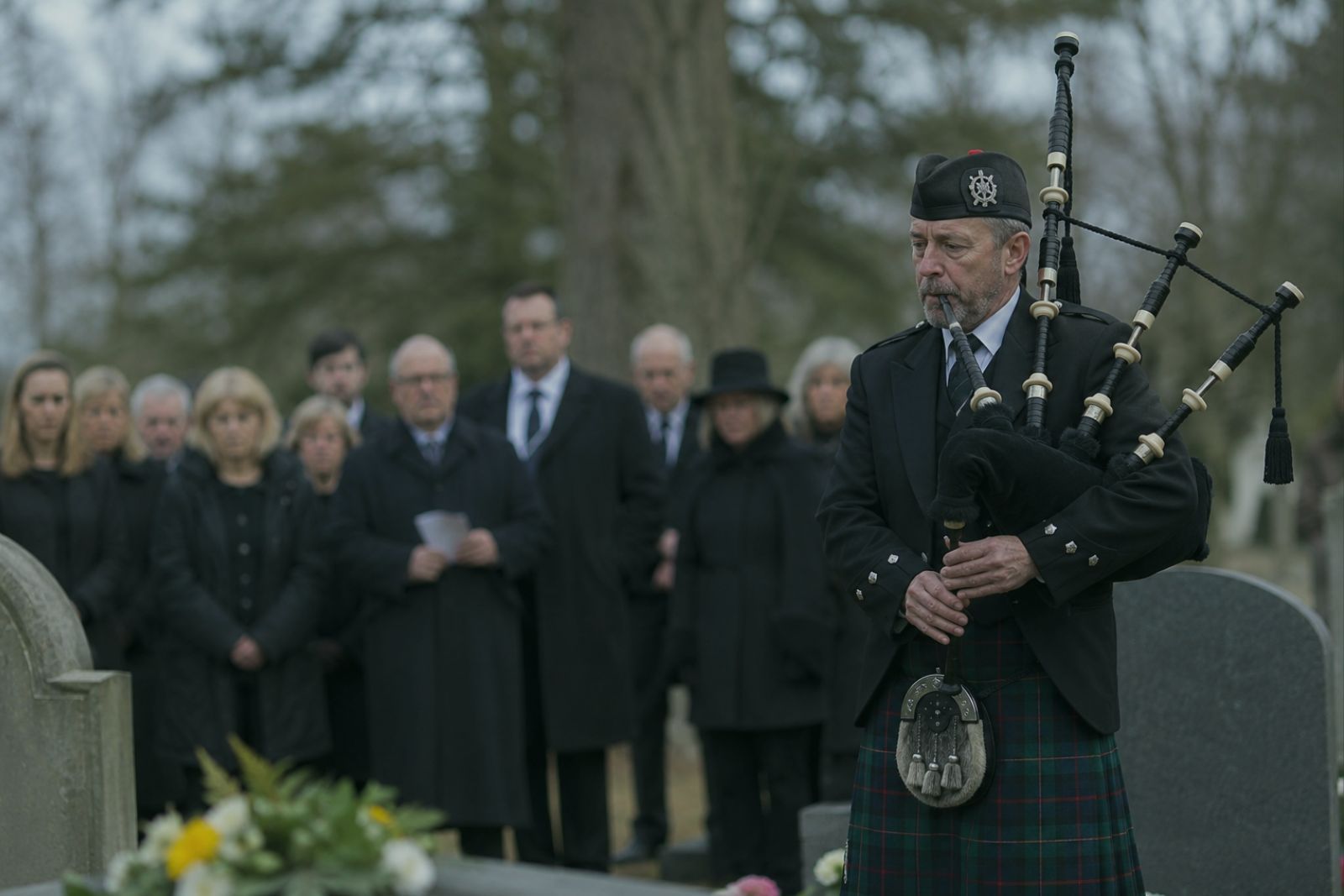
Every time there is a police or firefighter funeral in an American film, the same scene appears: a uniformed piper, alone, playing Amazing Grace from a distance. The scene is so familiar that we no longer ask why. But the reason is not aesthetic, it is not ancient, and it has nothing to do with Scotland in the way people imagine.
The only job available
In the mid-nineteenth century, the Great Famine expelled more than a million people from Ireland in less than a decade. Many arrived on the East Coast of the United States. Those who reached New York, Boston or Philadelphia found a society that did not want them: signs on shop doors reading “No Irish Need Apply”, relegated neighbourhoods, concentrated poverty, active discrimination.
In that context, two public jobs were among the few accessible to newly arrived Celtic immigrants: the fire brigades and the police departments. Not because there was any welcome, but because they were hard, poorly paid, and high-mortality work. They were left for them because nobody else wanted them.
Irish and Scottish immigrants took them. And with them, they brought their customs.
Bagpipes at the funerals of the fallen
When a colleague died in the line of duty, the community responded with what it knew how to do: a Celtic funeral. Bagpipes had accompanied the burials of their dead long before they arrived in America. It was not a conscious cultural gesture — it was simply what was done.
Over time, these communities created the Emerald Societies: associations of firefighters and police officers of Irish origin that formalised the tradition, organised pipe bands and drums, and turned it into the official protocol for service funerals. From there it spread to the military and to emergency service families in general, by then without distinction of origin.
The rite stopped being Irish and became American. But the bagpipes remained.
Why the Scottish bagpipe and not the Irish
Here is a technical detail that matters. Ireland has its own bagpipe: the Uilleann pipe, a beautiful, chromatic instrument with a soft timbre. It is played seated, with the bellows under the arm. Moderate volume, very interior.
The Great Highland Bagpipe — the bagpipe of the Scottish Highlands — is another thing entirely. It is played standing, in motion, with the bag under the left arm and the drone over the shoulder. Its volume is massive: in the open it can be heard several hundred metres away. It was designed to be heard on the battlefield before modern artillery existed.
For a funeral on a Manhattan avenue, with traffic and crowds, the Uilleann pipe does not carry. The Great Highland Bagpipe does. The choice was not cultural: it was acoustic.
The 1972 boom
All of the above explains why there were bagpipes at American funerals from the nineteenth century onward. But the image — the automatic association between Amazing Grace and the bagpipes — has a precise date.
In 1972, The Royal Scots Dragoon Guards, a cavalry regiment of the British army, recorded Amazing Grace with bagpipes and drums. It was a global hit at a moment when television was distributing images on a massive scale.
| Detail | Value |
|---|---|
| Recording date | 10 December 1971 |
| Label | RCA Records |
| UK chart position | No. 1 for 5 weeks (April 1972) |
| US chart position | Top 11 on the Billboard Hot 100 |
| Copies sold | More than 7 million worldwide |
From that point on, the connection was sealed. Not as a decision, but as cultural sediment: millions of people heard that recording in an emotional context — on the radio, on the family television, in the news — and the association was fixed. Bagpipes had already been playing at American funerals for more than a century. The 1972 record universalised them as the sound of grief.
The ritual as emotional architecture
The current protocol of the bagpipe funeral is not arbitrary. It has a structure that does something concrete with time and space.
The piper begins to play from a distance, alone, before the ceremony begins. You hear them from afar without seeing them. Then the pipe band joins: more bodies, more presence, the living and the community surrounding the dead. At the end, the piper walks away playing, alone again, until the music fades into the distance.
Entry of the soul, presence of the living, departure. There is no need to explain it because the music already does.
That architecture — the sound that arrives from far away, that envelops, that recedes — is something the bagpipes can do that few instruments can replicate at the same physical scale. It is not metaphor. It is acoustics applied to ritual.
What I recognise from here
I play at funerals. Not many, but I do. And what that American ritual describes — the solitary piper, the distance, the sound that fades — feels familiar to me not because I copied it, but because it responds to the same logic.
The Asturian gaita also has a repertoire for the dead. The processional march is not the same piece as Amazing Grace, and the context is not the same, but the function is identical: to create a suspended time in which grief can exist without anyone having to explain anything. Just as the alborada opens a romería or a wedding, the march accompanies the dead. They are the two faces of the same trade, and both demand the same thing: do it truly or do not do it at all.
I wrote about this in another way when I spoke of Fervienza, the piece I composed to join those who are here with those who are gone: the bagpipe as a tool for naming what cannot be said any other way. I tell that story in Composing from the root.
The Celtic tradition and the Asturian one never met in America. But the wind instrument doing what it has always done — accompanying the dead, giving sound to grief — is the same impulse on both sides of the Atlantic.
Bibliography
On Celtic immigration and the emergency services:
- Johnson, K. (2019). The Evolution of Firefighter Funeral Ritual. Undergraduate Research Journal, University of Nebraska at Kearney — analyses how Irish and Scottish immigrants introduced the Highland bagpipe as the cornerstone of corporate funeral rituals.
- Ignatiev, N. (1995). How the Irish Became White. Routledge — a reference work on the social and labour discrimination against Celtic immigrants in the nineteenth century and their entry into police and fire departments.
On the acoustic difference between bagpipes:
- Eastern United States Pipe Band Association (EUSPBA) and historical manuals from the Emerald Societies — document the technical difference between the Uilleann pipe (bellows-driven, chamber volume) and the Great Highland Bagpipe (mouth-blown, 100+ dB, designed to march in open field).
On the 1972 hit:
- The Royal Scots Dragoon Guards, Amazing Grace (RCA Records, 1972) — No. 1 on the UK Singles Chart for 5 weeks, top 11 on the Billboard Hot 100, more than 7 million copies sold worldwide.
On the funeral ritual protocol:
- National Fallen Firefighters Foundation (NFFF) and Line of Duty Death protocols from the NYPD and CPD pipe bands — detail the choreography of the solo piper, the final fading, and the symbolic reading of each verse.
Frequently asked questions
-
How long have bagpipes been played at American funerals?
Since the mid-19th century, when the Irish Great Famine triggered massive emigration to the US East Coast. Celtic immigrants who joined the fire and police departments recreated traditional funerals with pipes when they lost a colleague in the line of duty.
The tradition has been active for more than 170 years. It was never imposed from above — it grew from below, from communities honoring their own dead the only way they knew how.
I tell the full story in Amazing Grace, pipes and funerals.
-
Does the Asturian gaita also play at funerals?
Yes. In Asturias, the gaitero has the same dual role as in the Celtic tradition: playing at festivals and at funerals. The processional march is the specific repertoire for accompanying the dead — solemn, paced for a procession, distinct in character from anything you’d hear at a village fair.
In Asturias the tradition never broke and was never formalized by any society: it’s been part of the trade for centuries. The gaitero shows up at both ends of the most important moments in community life.
I write about the gaita’s relationship with death and ceremony in Amazing Grace, pipes and funerals.
-
Why is Amazing Grace played with pipes at American funerals?
The tradition didn’t start with an aesthetic decision. In the mid-1800s, Irish and Scottish immigrants arriving on the US East Coast faced heavy discrimination and could only access dangerous jobs like police and fire departments. When a colleague died in the line of duty, the community responded with a Celtic funeral with pipes.
The Emerald Societies formalized that custom and organized bands. In 1972, the recording by The Royal Scots Dragoon Guards made it universal — a pop hit that fixed the association in the Western collective memory for good.
I tell the full story in Amazing Grace, pipes and funerals.
-
Why is Amazing Grace played with pipes at funerals?
The association between “Amazing Grace” and pipes at funerals didn’t start as an aesthetic choice: it came from immigration history and an unexpected pop hit.
In the mid-1800s, Irish and Scottish immigrants on the US East Coast faced heavy discrimination and could only get dangerous jobs — police and fire departments. When a colleague died in service, the community held Celtic funerals with pipes. The Emerald Societies spread and formalized that tradition, choosing the Scottish Great Highland Bagpipe over the Irish uilleann pipe because they needed outdoor volume: parades and open-air funerals in city streets demanded projection beyond 100 dB.
In 1972, The Royal Scots Dragoon Guards recorded the track as a near-accidental side project. It reached number 1 in the UK for five weeks and sold over 7 million copies worldwide. That recording fixed the connection in the Western collective memory.
The full story is in Amazing Grace, pipes and funerals.
-
Why are Scottish pipes used at funerals instead of Irish pipes?
The reason is acoustic, not cultural. The Irish traditional pipe — the uilleann pipe — is played seated, with a bellows under the arm, and has a volume suited for indoor playing. Beautiful indoors; insufficient for outdoor crowds and open-air processions in city streets.
The Scottish Great Highland Bagpipe exceeds 100 dB and was designed for the battlefield — built specifically to be heard across noise and distance. For parades and outdoor funerals, the choice wasn’t about which tradition was more “Celtic”: it was about which instrument carried.
The uilleann pipe wasn’t overlooked out of bias. It just can’t do the job in the open air.
I explain the full context in Amazing Grace, pipes and funerals.
-
What are the Emerald Societies?
The Emerald Societies are associations of firefighters and police officers of Irish origin founded in cities on the US East Coast. They formalised the tradition of using pipes at funerals for those in service, organised pipe and drum bands, and turned the rite into the official protocol for military and emergency-service funerals. Today the tradition extends to families of all backgrounds within the emergency services.
-
Who popularized Amazing Grace with pipes?
The Royal Scots Dragoon Guards, a cavalry regiment of the British Army, recorded the tune in December 1971. The single reached number 1 on the UK Singles Chart for five weeks in April 1972 and the top 11 of the US Billboard Hot 100, selling more than 7 million copies worldwide. From that moment the association between Amazing Grace and the pipes became fixed in the Western collective subconscious.