Comparison · Traditional Music
Asturian bagpipe vs. Great Highland Bagpipe: the real differences
Two bagpipes that get confused from the outside but sound and play differently: single drone versus three drones, flexible scale versus fixed scale, solo-piper tradition versus pipe band. The real differences, from having played both.
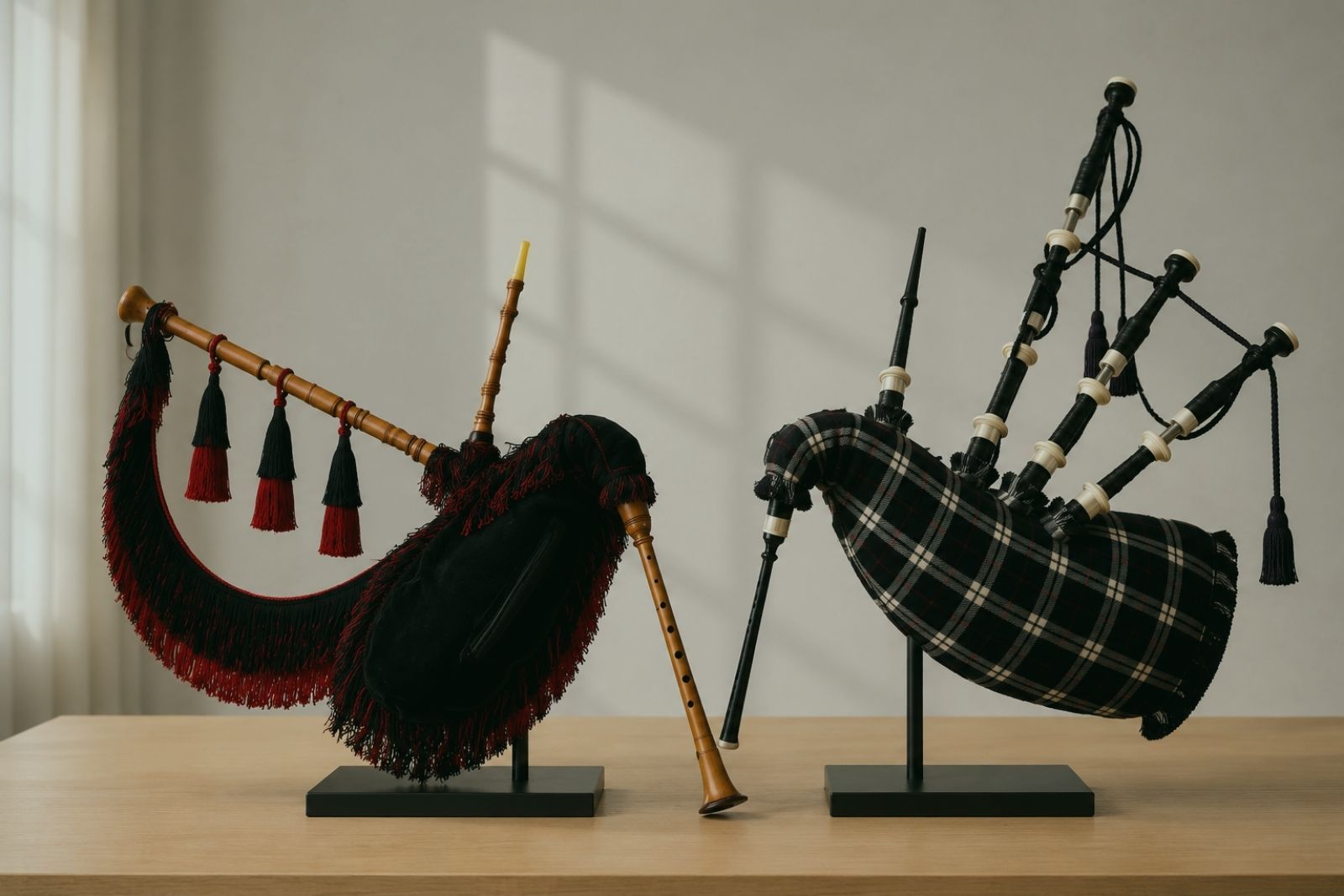
When we play festivals outside Spain, I get asked this constantly: “is your bagpipe like the Scottish one?” The short answer is that they share more than they seem to at first glance —both are mouth-blown, both have a conical chanter— but they part ways on design decisions that change how they sound and what they are for: number of drones, scale and context of use.
I have played the Asturian gaita my whole life and I’ve had Scottish bagpipes in my hands at gatherings and collaborations with bands. This is what I learned comparing them up close, not from hearsay.
Origin and organological family
Both belong to the same broad family: European bagpipes with an air reservoir (the bag), a melodic tube and one or several drones that sound continuously beneath the melody. They share that basic structure with the Galician gaita, the Irish uilleann pipe and the rest of the bagpipes of the Atlantic arc.
The Asturian gaita is the instrument proper to the musical tradition of Asturies, historically tied to the solo piper and to the music of the romería, alborada and festivu. The Great Highland Bagpipe —the Scottish bagpipe, the best known in the world— has a different history: it was consolidated as an instrument of war and military parade, tied to regiments and, later, to competition pipe bands.
Two mouth-blown bagpipes with a conical chanter, yes. But one is born of the piper who plays alone in the square; the other, of the band formation with sheet music and uniform. That different root explains much of what follows.
The main technical differences
Air system: two ways of blowing, one same principle
Here is the real resemblance, and it’s worth stating first because it’s what confuses people most who don’t know either instrument from the inside.
Both the Asturian gaita and the Great Highland Bagpipe are inflated by blowing through a blowpipe with the mouth, with no elbow bellows. That sets them apart from the Irish uilleann pipe or the Northumbrian pipes, which use a mechanical bellows under the arm —I go into more detail in Asturian gaita vs. uilleann pipe.
The difference between the Asturian and the Scottish gaita is not in the air-intake mechanism, but in what has to be sustained afterwards: the Scottish bagpipe splits the pressure across three drones plus the chanter; the Asturian one, across a single drone. Sustaining constant pressure for four tubes sounding at once —three drones and the chanter— demands a different bag control than sustaining it for two.
Drones: one versus three
This is the difference that shows and sounds the most.
The Asturian gaita carries, in its traditional form, a single roncón: a tube resting on the shoulder. Its function, whether the instrument has one, two or three roncones, is always the same: to sustain a continuous drone sound beneath the melody —a fixed note, or two or three if the instrument carries more than one roncón. As a solo instrument, that drone fills a lot of sonic space on its own; in a band, with several roncones well tuned to each other, the combined effect is powerful.
The Great Highland Bagpipe carries three drones: one bass drone and two tenor drones, tuned to the octave and to the octave below the tonic of the chanter. All three sound simultaneously in a fixed, easily recognisable chord, which is a good part of what we identify from a distance as “the sound of Scottish bagpipes.” That three-drone architecture —not two, not four— is one of the organological traits that define the Highland within the family of mouth-blown or elbow-bellows bagpipes of the British Isles.
An important precision is due here: Asturian gaitas with two or three roncones exist, and they are not a rarity. Bandes de gaites such as those of Candás or Villaviciosa play gaitas with three roncones. That design comes directly from the exchange with Scottish bands: in the nineties, when Scottish bands were headlining every international festival, Asturian master pipers adopted that multi-drone architecture for the Asturian gaita, looking for a band sound body similar to the Highland’s. The traditional, root form remains a single roncón, but the two- or three-roncón instrument is today a living, established reality on the band side, not a laboratory anecdote.
Scale and chromaticism: fixed versus flexible
The Great Highland Bagpipe plays over a fixed nine-note scale, mixolydian in character, with no chromatic semitones and no way of altering it with keys: the chanter has no keys, and that closed scale is a hallmark of the march, strathspey and reel repertoire of the pipe band tradition.
The Asturian gaita also started from a diatonic scale without chromaticism, but its later path was different: thanks to the work of Asturian luthiers and pipers, the modern punteru incorporates keys that allow it to cover a full chromatic register. I go into this in detail in How many notes does the Asturian bagpipe have?. That flexibility opens up repertoire the fixed Scottish scale does not reach: from melodies with accidentals to arrangements meant to be played alongside other tempered instruments.
It’s not that one scale is better than the other. The Scottish one’s fixity is functional: a whole band tuning to the same closed reference sounds compact. The Asturian one’s flexibility answers a different need, that of the solo piper who wants to expand repertoire.
Timbre, volume and context of use
Both are designed for the outdoors and both have considerable volume —neither is a small-room instrument, unlike the uilleann pipe. But the social context in which they sound is different, and that shows in the ear.
The Great Highland Bagpipe is associated today, above all, with ensemble sound: the pipe band, with several chanters and batteries of drones sounding as a block, marching in formation. But alongside that band tradition there is a demanding solo tradition of its own, that of piobaireachd (or pìobaireachd) and solo light music competition —marches, strathspeys, reels— with an extremely high technical level and its own championship circuit. It is not an instrument meant only for group playing: the discipline of collective tuning in the pipe band coexists with an individual technical demand that is comparable, or greater, on the solo side.
The Asturian gaita has a strong solo-piper tradition: one or two pipers accompanying a romería, an alborada, a festivu, with no military formation behind them. Asturian bandes de gaites exist and are a living part of the tradition, with their own technical level, but the instrument was not born there.
Ornamentation
Both build their ornamentation on open-hole fingering, with no keys on the Scottish side and only partial keys on the modern Asturian one. But the grammar of ornaments belongs to each tradition: the Highland has its own closed, codified catalogue of grace notes, doublings and taorluaths, with names and rules fixed by pipe band pedagogy. The Asturian gaita has its own —picado, fol vibrato, slurs of Asturian root— passed down more openly, from master to pupil, without the same degree of military codification.
What they have in common
The resemblance is not just the “bagpipe” label.
Both are mouth-blown, conical-chanter instruments, which brings them closer in timbre than either is to the uilleann pipe or the Northumbrian pipes, both elbow-bellows and cylindrical-chanter. Both are designed to sound loud outdoors. And both are identity symbols of their people: the Scottish one for Scotland and the Scottish diaspora around the world; the Asturian one, for Asturies.
Both, moreover, are part of that European Atlantic arc I cover in A guide to the bagpipes of the Atlantic arc, alongside the Galician, Breton and Irish gaitas.
The musician’s question: if you play one, do you play the other?
I get asked this mostly by band pipers who cross paths with the Asturian gaita at some gathering.
There is partial transfer, and it runs both ways. If you play the Asturian gaita, mouth-blowing and bag control are not foreign to you when moving to the Scottish one; the challenge is sustaining stable pressure for three drones at once and learning the closed ornament catalogue of the pipe band tradition, which is demanding and highly codified —both on the band side and on the solo competition side.
If you play the Great Highland Bagpipe, blowing isn’t new either, but the flexible, keyed scale of the modern Asturian gaita forces you to rethink how you approach repertoire, and properly sustaining a single roncón —or two or three, if the instrument carries them— requires a different pressure control than a fixed three-drone architecture.
As with the uilleann pipe, there are pipers who master both. But they get there by studying each one separately, not by family resemblance.
Quick comparison
| Feature | Asturian gaita | Great Highland Bagpipe (Scottish bagpipe) |
|---|---|---|
| Air system | Mouth blown (blowpipe) | Mouth blown (blowpipe) |
| Drones | One roncón (traditional root); two or three on band gaitas since the 1990s | Three drones: bass + 2 tenor |
| Scale | Diatonic at the root; chromatic in modern keyed models | Fixed 9-note mixolydian, no keys |
| Chanter | Conical | Conical |
| Traditional context | Solo piper (romería, alborada, festivu) and bandes de gaites | Competition pipe band and solo piobaireachd tradition |
| Ornamentation | Picado, fol vibrato, slurs of Asturian root | Codified catalogue: grace notes, doublings, taorluaths |
| Social function | Symbol of Asturian identity, oral tradition | Symbol of Scottish identity, tied to regiments and diaspora |
| Technical transfer | Partial: blowing is familiar; fixed scale and triple drone are new | Partial: blowing is familiar; keys and single roncón are new |
Bibliography
- Baines, Anthony. Bagpipes. Oxford: Pitt Rivers Museum, 1960. — A comparative study of European bagpipes; includes the organology of the Great Highland Bagpipe within the family of Atlantic bagpipes.
- Fernández, Xulio. La gaita asturiana: historia, técnica y repertorio. Oviedo: Caja de Ahorros de Asturias, 1991. — The reference monograph on the organology of the Asturian gaita.
- Fernández García, Juan Alfonso. Catálogo de la exposición permanente del Museo de la Gaita. Xixón: Muséu del Pueblu d’Asturies, 2018. — Organology and history of the Asturian gaita from the collection of the Museu de la Gaita.