Essay · Traditional Music
A guide to the bagpipes of the Atlantic arc
A guide to the most representative gaitas of the Atlantic arc —Scottish, Irish, Breton, Galician, Asturian and more— ordered by organological axes rather than by country. Where the Asturian gaita fits and why it is not just one more «Celtic bagpipe».
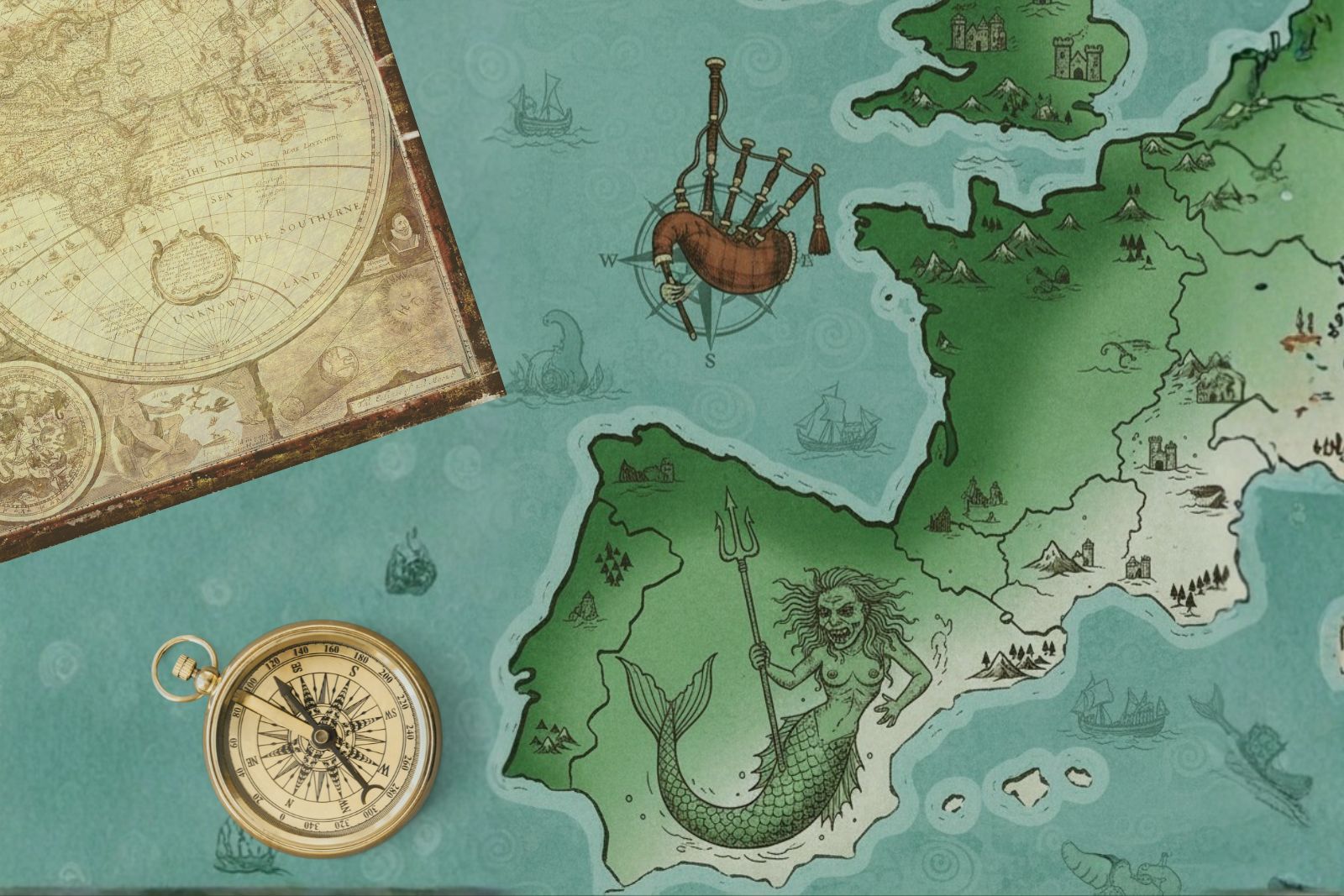
The Atlantic arc is the Atlantic seaboard of Europe understood as a space of cultural exchange —from Scotland to Galicia, by way of Ireland, Brittany and the Cantabrian coast— where the gaita is the common instrument. This is a guide to its most representative gaitas: what they are, where they are from and how they differ, ordered not by flags but by how they are made. And where the Asturian gaita —mine— fits in: it has relatives enough without needing to call itself just one more «Celtic bagpipe».
I play the Asturian gaita and I have put others from the arc into my own hands. This is the guide I would have liked to have: an overview map to come back to —and to link to— when someone asks about the bagpipes of Scotland, Ireland, Brittany or the Iberian northwest. The detailed comparisons I keep in other articles; here is the plan that frames them all.
Why «Celtic» does not work as a map
Throwing everything into the «Celtic» drawer is convenient for selling a concert across Europe, but it describes nothing: not the tuning, not the number of drones, not how the air gets in. «Celtic» is an export label, not an organological category.
The Asturian gaita has relatives without needing that label: it shares a trunk with the Galician gaita and the gaita de fole, and it shares the arc with the bagpipes of Scotland, Ireland and Brittany. But kinship is not identity: a family is understood through the traits it shares and the ones that set it apart, not by sticking the same word on all of them.
The axes that really order the gaitas
The honest way to compare gaitas is not by country, but by organological traits. These are the ones that truly tell them apart:
- Air supply — mouth-blown (through the blowpipe) or elbow-bellows (a bellows under the arm, with dry air). Mind the term: in Asturies the bagpipe is called «gaita de fuelle» because fuelle is the bag; the elbow bellows is something else, the one that feeds air into the Irish or the Northumbrian pipes.
- Chanter bore — conical (bright and powerful) or cylindrical (softer).
- Chanter end — open or closed (it cuts the note, gives staccato phrasing; almost a rarity in the arc).
- Keys — keyless (most of the Iberian ones) or keyed (keys or regulators that extend the range).
- Number of drones — from one to three or more.
- Tuning — tempered or non-tempered (the root of many traditional ones).
- Function and space — outdoor and powerful (romería, square) or indoor and soft (room, session).
- Tradition — living (unbroken transmission) or recovered (broken and set back on its feet in the twentieth century).
The number of drones deserves a note of its own. The traditional Asturian gaita carries a single roncón —that low tube that rests on the shoulder and holds a continuous note beneath the melody. The single roncón is the traditional base: the two- and three-drone models came later, in the nineties, after contact with Scottish pipers and bands and the search for a sound close to theirs. It is part of the evolution of the bandas de gaites.
The master table
| Axis | Poles | Who falls on each side |
|---|---|---|
| Air supply | Mouth-blown ↔ elbow-bellows | Mouth-blown: Asturian, Galician, de fole, Highland, biniou, veuze. Elbow-bellows: Northumbrian, uilleann, Scottish smallpipes and border pipes |
| Chanter bore | Conical ↔ cylindrical | Conical: Asturian, Galician, Highland, biniou. Cylindrical: Northumbrian, smallpipes |
| Chanter end | Open ↔ closed | Closed (staccato): Northumbrian. Open: the rest |
| Keys | Keyless ↔ keyed | Keyless: most of the Iberian ones and the Highland. Keyed: Northumbrian, the uilleann regulators |
| Number of drones | 1 ↔ 3 (+) | 1: traditional Asturian, biniou kozh, veuze. 3: Highland, Northumbrian, biniou braz. Variable: Galician, uilleann |
| Tuning | Tempered ↔ non-tempered | Non-tempered: root of many traditional ones. Tempered: the modern, chromatic Asturian |
| Function / space | Outdoor ↔ indoor | Outdoor: Highland, biniou. Indoor: Northumbrian, uilleann |
| Tradition | Unbroken ↔ recovered | Living: Asturian, Galician, Highland, Northumbrian, uilleann, biniou. Recovered: Scottish smallpipes |
The Iberian branch: the gaita de fuelle
The family of the gaita de fuelle —gaita de fol or de fole in Galician and Portuguese— is the Iberian heart of the arc. Three living branches of one and the same trunk:
- Asturian gaita. The bagpipe proper to Asturies. Mouth-blown, conical punteru, double reed —the payuela— and, traditionally, a single roncón. A living tradition, present at romerías, alboradas and in the banda de gaites.
- Galician gaita. Double reed, conical punteiro, one to three drones. Smaller than the Asturian, with its own songbook. A direct sister.
- Gaita de fole. The cross-border bagpipe of Sanabria and Aliste (Zamora), Trás-os-Montes and Miranda (Portugal): sanabresa or alistana in Spain, transmontana or mirandesa in Portugal.
To these one usually adds the Cantabrian gaita (or Asturo-Cantabrian), of the same family as the Asturian; caution is in order, because it was displaced in the twentieth century by the pitu montañés and recovered late.
The British Isles and Ireland
- Great Highland Bagpipe (the Scottish bagpipe). Mouth-blown, conical chanter, three drones and a powerful outdoor sound. It is the best-known bagpipe in the world: it shares the blow and the cone with the Asturian, but the drones, the tuning and the repertoire set them apart.
- Scottish smallpipes and border pipes. Elbow-bellows; the smallpipes cylindrical and soft, the border conical and more sonorous. Recovered in the twentieth century.
- Northumbrian smallpipes. Elbow-bellows and the oddity of the family: a cylindrical and closed chanter, which gives a very crisp staccato fingering. Keyed, soft, indoor; it is often cited as the only English bagpipe of unbroken tradition.
- Uilleann pipes (the Irish bagpipe). Elbow-bellows, two octaves, with regulators that allow chords. Sweet, indoor. The fine differences with the Asturian I break down in Asturian gaita vs. uilleann pipe.
Brittany
- Biniou kozh («old biniou»). Mouth-blown, one of the smallest bagpipes in the world: a register an octave above the Scottish, shrill and piercing. It plays in a pair with the bombarde.
- Veuze. Mouth-blown, from the Nantes country and the Vendée. It is regarded as the ancestor of the Armorican wind instruments.
- Biniou braz («big biniou»). An adaptation of the Scottish Highland from the early twentieth century; today it dominates the bagadoù, the Breton bands.
The map does not end here
These are the most representative gaitas of the arc, not all of them. Left out for now are those at the edges —with recovered traditions—: the Welsh one (mind: the Welsh pibgorn is a horn clarinet without a bag, not a bagpipe), the Cornish or the Manx one, plus local variants of each area. I will be speaking of these and others, one by one, on the blog.
Where the Asturian one stands
Set against these axes, the Asturian gaita locates itself precisely and without borrowed labels: mouth-blown, with a conical chanter, a double reed (the payuela) and a single drone at its root, as against the elbow-bellows bagpipes of the British and Irish side. Its tuning tells another story: diatonic at the root, it evolved towards temperament and today it is chromatic, ready to play with anyone.
And, above all, alive: it is no museum piece nor a Celtic souvenir for export, but an instrument that is played today. Knowing the family does not dissolve the Asturian into an «it’s all the same»; it sharpens it. Mine I do not call bagpipe or cornemuse abroad —each one is its own gaita, as I tell in gaita, bagpipe, cornemuse—, and its differences with its nearest sister are in Asturian gaita vs. Galician gaita.
Bibliography
- Baines, Anthony. Bagpipes. Oxford: Pitt Rivers Museum (Occasional Papers on Technology, 9), 1960. A typology and kinship of the European bag-fed bagpipes; the starting point for understanding the shared family.
- Fernández García, Juan Alfonso. Catálogo de la exposición permanente del Museo de la Gaita. Xixón: Muséu del Pueblu d’Asturies, 2018. Organology and history of the Asturian gaita from the collection of the Museo de la Gaita.
- Van Hees, Jean-Pierre. Cornemuses, un infini sonore. Coop Breizh. An organological catalogue of the cornemuses classified by families —useful for placing the Atlantic arc and its Breton gaitas.
Frequently asked questions
-
Which gaitas make up the gaita de fuelle family?
The Iberian branch of double-reed bagpipes of the peninsular northwest: the Asturian gaita, the Galician gaita and the gaita de fole of Sanabria, Aliste and Trás-os-Montes (gaita de fol or de fole in Galician and Portuguese). The three come from one and the same trunk that grew apart over time. The Cantabrian gaita is of the same family, although it was displaced in the twentieth century and recovered late.
-
Is the Asturian gaita a Celtic instrument?
Not in an organological sense. «Celtic» is a cultural export label, not a category that describes how a gaita is made. The Asturian gaita is a mouth-blown bagpipe, with a conical chanter, a double reed and a single drone at its root. It belongs to the family of the gaita de fuelle and to the Atlantic arc —sister of the Galician one and cousin of the Scottish or the Irish— but with an identity of its own. The kinship is real; the «Celtic» label, borrowed.
-
How does a mouth-blown gaita differ from an elbow-bellows one?
In how the air gets into the bag. In the mouth-blown one (Asturian, Galician, Scottish, biniou) the player blows through the blowpipe with the breath; in the elbow-bellows one (uilleann, Northumbrian, Scottish smallpipes) a bellows under the arm does it with dry air. The reed of the Asturian one —the payuela— works with the moisture of the breath; the elbow-bellows ones use a reed that does not need it.