Essay · Traditional Music
Gaita, bagpipe, cornemuse: what to call the Asturian gaita in each language
Why I call the Asturian gaita a gaita in English and French too, how it relates to «bagpipe» and «cornemuse», and why keeping the proper name is a cultural decision, not an oversight.
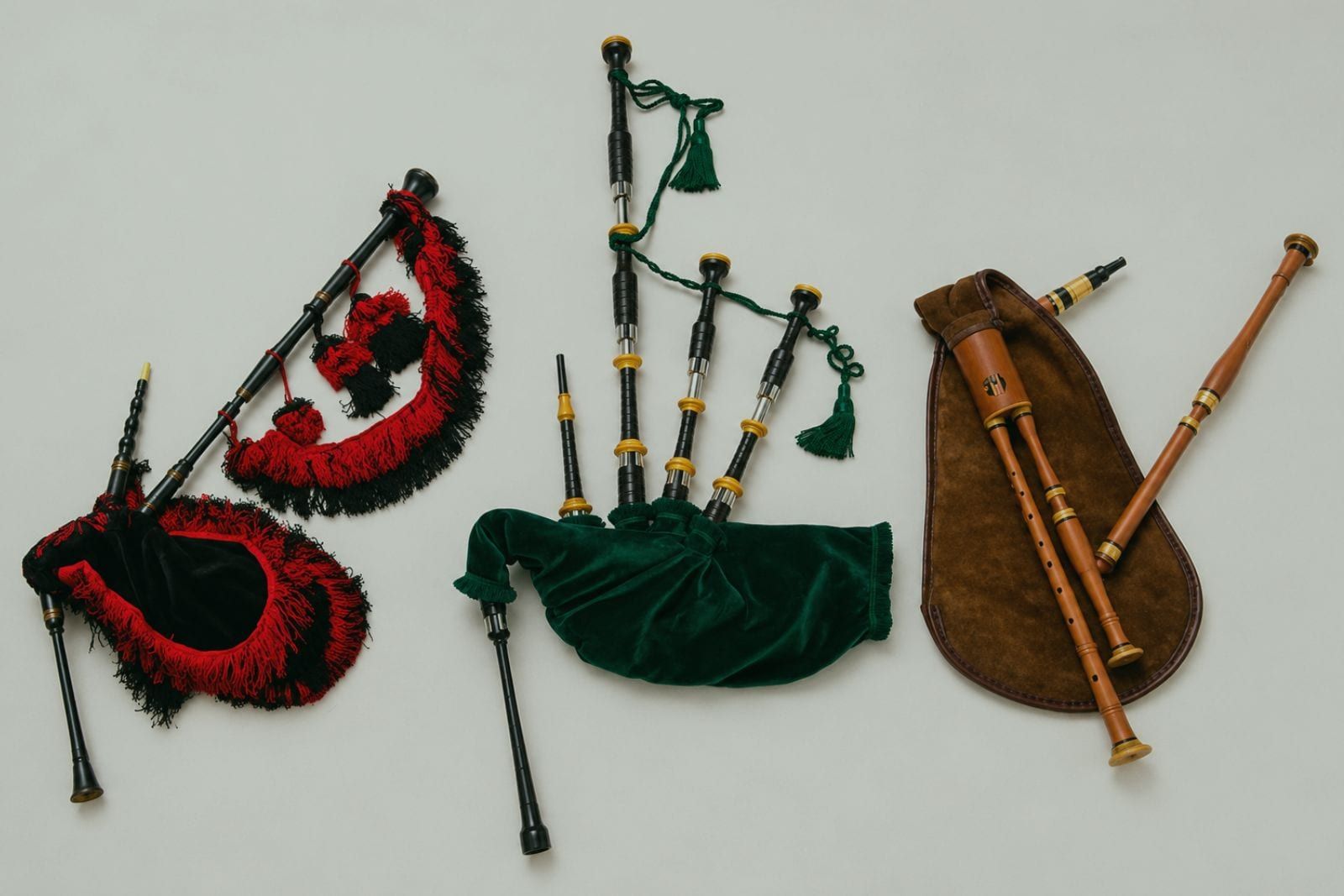
When I talk about my instrument outside Asturies, people always ask me the same thing: “is that a bagpipe?”, “c’est une cornemuse?”. The short answer is: yes and no. Yes, it belongs to that family; no, that isn’t its name. Its name is gaita. And I call it gaita when I write in English or French too, on purpose.
This isn’t a translation slip: it’s a decision. Let me tell you why.
«Gaita» is a proper name, not a translation still pending
Some words travel without being translated because they name something with an identity of its own. Nobody translates fado, flamenco or sitar: they’re said the same everywhere, and that permanence is part of what they are. The same goes for the Asturian gaita. “Gaita” isn’t a generic word meaning “bag-and-reed wind instrument”; it’s the name of this particular instrument, with its tuning, its repertoire and its way of sounding.
Translating it as “bagpipe” or “cornemuse” would dissolve it into a huge category where the first thing that comes to mind is something else —the Scottish one, almost always. Keeping “gaita” in any language is keeping the instrument as its own.
What «bagpipe» and «cornemuse» actually mean
Both words exist and are useful, but they do a different job from the one people assume.
| Term | Language | Scope | Example it evokes |
|---|---|---|---|
| Gaita | Spanish/Asturian | Proper name of the Asturian instrument, not translatable | The Asturian gaita, mine |
| Bagpipe | English | Generic: any bag-and-reed pipe | Scottish Great Highland Bagpipe, in military uniform |
| Cornemuse | French | Generic: any European bag-and-reed pipe | French Cornemuse du Centre |
They’re categories, not names. They serve to place the Asturian gaita for someone starting from scratch —“yes, it’s in the bagpipe family, like the other gaitas of the Atlantic arc”— but not to replace its name.
How I handle it in practice
The rule I follow on this site, across the three non-Castilian languages, is simple:
- The instrument is always called «gaita». In English, the Asturian gaita; in French, la gaita asturienne.
- The first time it appears, I place it with the generic for anyone who doesn’t know it: the Asturian gaita, a bagpipe from northern Spain / la gaita asturienne, une cornemuse du nord de l’Espagne.
- From there on, gaita on its own. Just as you’d do with fado after explaining once that it’s a Portuguese song genre.
That way anyone searching for “asturian bagpipe” or “cornemuse asturienne” finds the site —because those terms are where they should be— but what they take away is the real name: gaita.
It isn’t purism: it’s precision
I don’t keep “gaita” out of nostalgia or stubbornness. I keep it because it’s more precise. The Asturian gaita isn’t a regional variant of the Scottish one, just as the Galician gaita isn’t a variant of the Asturian one, nor is the uilleann pipe a simplified version of either. They’re sibling instruments, each with its own personality, and calling them all “bagpipe” erases exactly what sets them apart.
Saying “gaita” in English or French is asking the listener for a small effort —learning a new word— in exchange for something honest: that the instrument arrives with its own name, not disguised as someone else’s.
Bibliography
- Baines, Anthony. Bagpipes. Oxford University Press, 1960. The reference taxonomy for European bag-and-reed pipes; the context for the term bagpipe as a category comes from here.
- Nettl, Bruno. The Study of Ethnomusicology. University of Illinois Press, 2005. On how the proper names of instruments work as cultural identity, not only as technical description.
Frequently asked questions
-
What is the difference between a bagpipe and a cornemuse?
No essential difference: both are generic terms in their respective languages for any bag-drone instrument. Bagpipe (English) almost always evokes the Scottish Great Highland Bagpipe in the Anglophone imagination. Cornemuse (French) covers any European bag-drone instrument.
They’re useful categories for placing an instrument in front of an audience starting from zero — but they’re not proper names for any specific instrument. Neither “bagpipe” nor “cornemuse” replaces “gaita asturiana” any more than “string instrument” replaces “violin.”
I explain how and when to use each term in Gaita, bagpipe, cornemuse: what do you call it?.
-
Why isn't "gaita" translated into English or French?
Because “gaita” is a proper name, not a generic description. Translating it to “bagpipe” or “cornemuse” would dissolve it into a vast category where the first thing that comes to mind is something else — usually the Scottish pipes.
Some words travel without translation because they name something with its own identity: nobody translates fado, flamenco, or sitar. The gaita asturiana is the same. The generic terms (bagpipe, cornemuse) serve to situate it for an audience starting from zero — but not to replace its name.
Using the translation erases the distinction. Keeping the name preserves it.
I go into this at length in Gaita, bagpipe, cornemuse: what do you call it?.