Guide · Traditional Music
What is the Asturian gaita mass
A Latin mass, sung in Asturian tonada style and accompanied by the gaita. What it is, where it comes from, how it sounds and why the Administration declared it a Bien de Interés Cultural in 2014. One of the oldest musical traditions of Asturias.
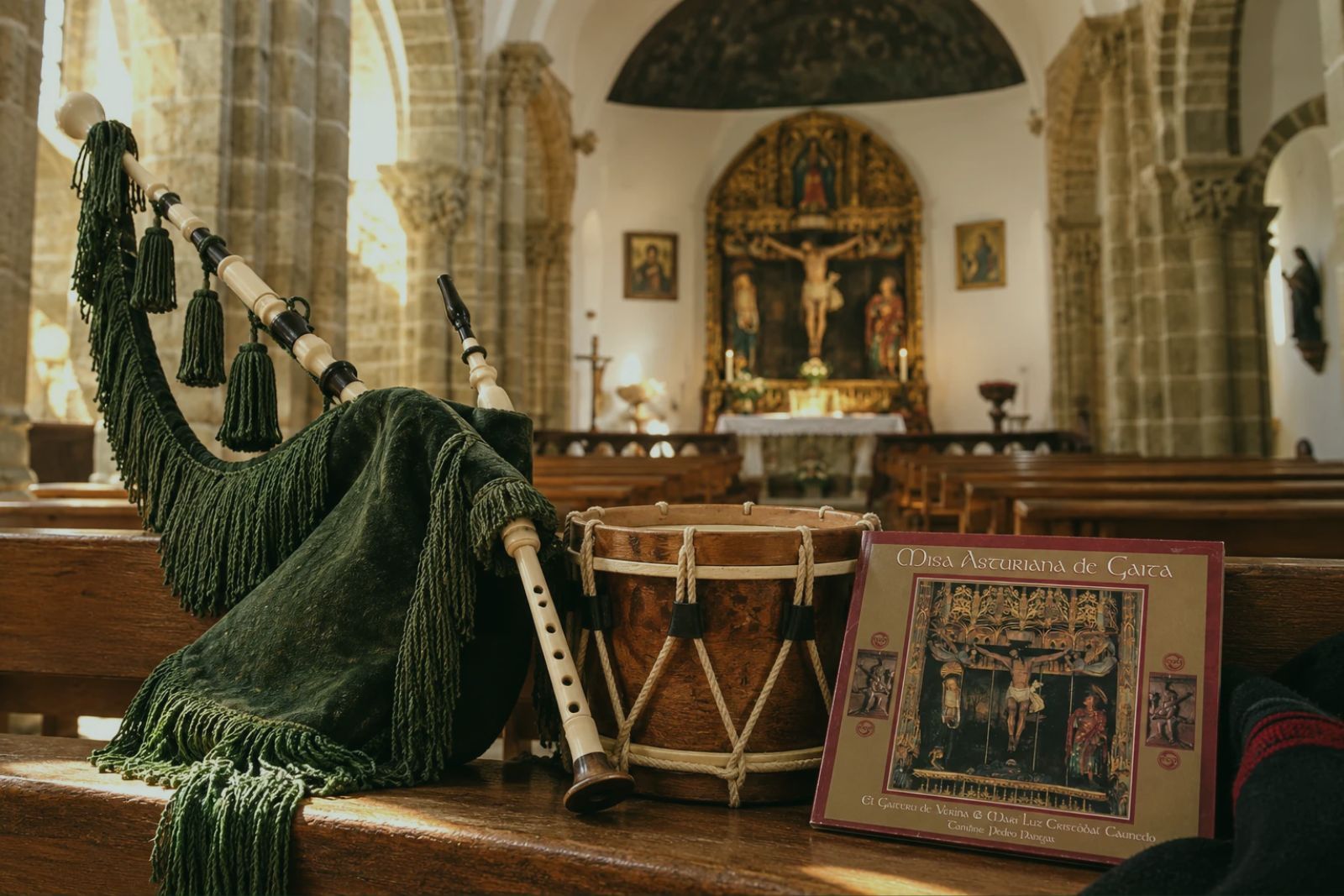
Imagine a village church on the day of the patron saint’s festivity. The mass is in Latin. But what accompanies the singer is not an organ: it is a gaita.
It seems an oddity, and it is. It is the Asturian gaita mass: a Eucharist sung in Latin and accompanied with the gaita de fuelle, the Asturian bagpipe. It is still alive in some concejos (municipalities) of Asturias —Llanes, Salas, Aller, Quirós and Lena— and since 2014 it has been a Bien de Interés Cultural, the highest form of protection for cultural heritage.
A mass with parts you recognise
If you have ever been to mass, you already know its skeleton. In the gaita mass the parts of the so-called Ordinary are sung, those that are repeated in every mass: Kyrie (a Greek word absorbed into the Latin mass that means «Lord, have mercy»), Gloria, Credo, Sanctus and Agnus Dei. The rest has been gradually lost: according to the Fundación Valdés-Salas, the introits —the entrance chants— and the Gloria Patri barely survive, and only in some areas is the Salve Regina also sung.
All of it has reached today mainly by ear, through oral tradition, although its starting points lie in choir books and printed editions of the Early Modern period. The Foundation speaks of a tradition «of at least four centuries». But the underlying melodies are much older, and to understand where they come from you have to go back a good deal further.
Where it comes from
The chant of the synagogues was the basis of early Christian chant. Over the centuries, each region developed its own plainchant —religious melody sung in one voice—: Gallican in Gaul, Beneventan in southern Italy, Visigothic-Mozarabic on the peninsula. The one we now call Gregorian is attributed, according to tradition, to Saint Gregory the Great, pope between 590 and 604, who is said to have collected and ordered it.
Those masses sung in Latin were a reality across half the Catholic world, above all in rural churches and chapels. The difference is that in Asturias they are still alive, and that here the age-old melody met an instrument that nobody expected in a church.
How it sounds
Think of a village. The parish priest wants a sung mass and uses what he has: the tonada singer —the traditional Asturian song— and the piper. From that meeting an Asturian version of the Latin mass is born.
The musicologist Ángel Medina, professor at the Universidad de Oviedo and author of La misa de gaita. Hibridaciones sacroasturianas, calls this mixture hybridisation: the plainchant melodies intersect with the ornamental turns of the gaita and with the way of singing of the tonada. That is why it does not sound the same everywhere. Medina distinguishes three centres —the centre-west, the south of the Principality and some localities of the east—, and even the masses of Salas and Aller, from the same trunk, differ.
Within each centre, the gaita does something very much its own: it doubles the singing in the upper register, with small offsets that give it a particular sound. It is what specialists call heterophonic accompaniment: voice and gaita sing the same melody, but not quite at the same time. And between one passage and another, the gaita slips in flourishes, to prelude or so that the performers can rest. Sometimes it is even left alone.
The entemedios: the gaita alone
Those moments for gaita alone, sometimes with drum, are the entemedios (interludes). They can sound at the entrance, at the offertory —when the bread and wine are presented—, at the consecration —the central moment, when the words are pronounced over them—, at communion and at the exit. For the consecration the Marcha Real (the melody of the Spanish anthem) traditionally sounded; today Asturias, patria querida, the anthem of the Principality of Asturias, also carries a lot of weight.
Many begin with a floréu d’entamu, the opening flourish: the one I teach in my classes and the one I analysed in the lab.
Bien de Interés Cultural: from tradition to heritage
A practice so singular ended up catching the attention of those who could protect it. At the request of the Fundación Valdés-Salas, the Muséu del Pueblu d’Asturies and the Universidad de Oviedo, Decree 65/2014, of 2 July, declared it a Bien de Interés Cultural of an intangible nature (BOPA, 11 July 2014).
The declaration did not leave it in a display case. The Foundation created a workshop for singers that bears the name of Lolo Cornellana (1950-2011), a gaita mass singer, and says that in Salas «at least thirty» masses are held a year. It is also studied: in 2017, Luis G. Pola presented at the Universidad de Oviedo a study of the gaita mass of Quirós, with one transcribed mass and three recovered introits.
Listen to it
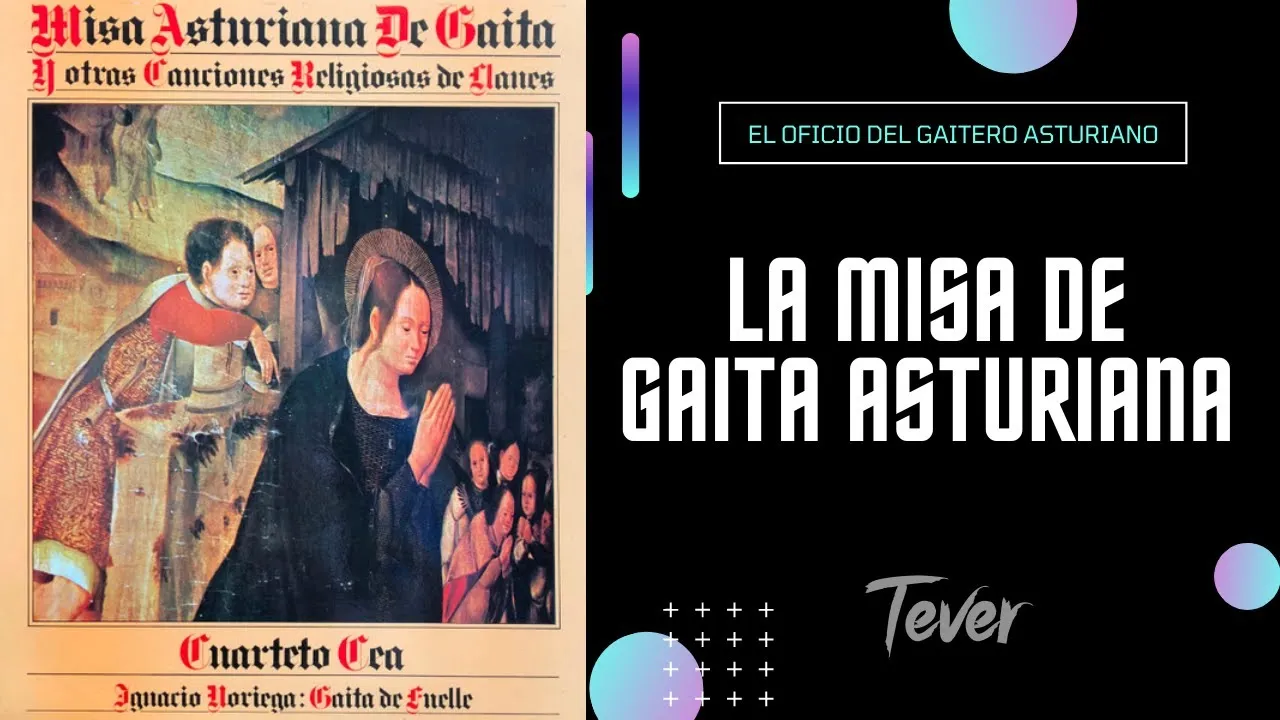
All this is better understood by hearing it. In the video I tell what you have just read and, from minute 6:41, I give an example: a Kyrie with the singing of Mari Luz Cristóbal and the gaita of the Gaiteru de Veriña, the protagonist of the third instalment of «Gaiteros de la Tradición». Medina dates that recording to 1996, with Pedro Pangua on drum; the Foundation lists a 1998 CD with Veriña and Pangua.
It is a repertoire you hardly ever see in music schools, and that is why I think it is important to have it to hand. And I am also interested in how it was lived by those who played it. In Teverga, for example, there was a piper whose daughter said, at a tribute in 1995, that his speciality was the gaita masses. The next post in the series «Gaiteros de la Tradición» is about him: Juan Rodríguez Huerta, «Juan el de la Torre».
Video transcript
Introduction
Today I talk about one of the gaita performances that we often do not know, above all in the more academic world of the gaita: the Asturian gaita mass. It is one of the oldest representations we have within our repertoire, and I want to share the main foundations so that a subject like this can be worked on.
The music of Latin masses
The chants in church come from a very old tradition, going back to the last years of the Roman era, when the emperor Theodosius adopted the Christian religion. The Jewish chant of the synagogues was the basis of early Christian chant, and the parts sung in masses come from there. The language of the mass was Latin, but from time immemorial each region developed its own plainchant: Gallican in Gaul, Beneventan in southern Italy, Old Roman in Rome, Visigothic-Mozarabic in Spain. Each region used its own customs to take part in the celebration.
Gregorian chant, the one that surely sounds familiar to you, takes its name from Saint Gregory the Great (590-604), who is considered the one who collected and organised it. It was among the first occasions on which music was put in order to be used in the mass, and that made it possible to structure the mass musically according to its order: the entrance, the Kyrie, the Gloria, the liturgy of the word (with the alleluia, the homily and the Credo), the offertory, the Eucharist and communion.
Kyrie eleison, Gregorian chant
To illustrate it, we listen to the Kyrie eleison by the choir of the abbey of Santo Domingo de Silos. Kyrie eleison means «Lord, have mercy». These are parts you already recognise if you ever go to mass; the only ones that in the Latin mass were identified with chants.
What is the Asturian gaita mass
The big question is where the gaita fits in. Imagine an Asturian village: the parish priest wants to hold the celebration with this kind of music, and who does he have at hand: the tonada singer and the piper. So, in Asturias, the Latin masses were recreated with versions of their own, putting into them the tradition, the music and the way of singing of each village. From that comes the Asturian gaita mass, and there is nothing better than listening to an example.
Kyrie eleison, Mari Luz Cristóbal and the Gaiteru de Veriña
We listen to a Kyrie played on the gaita by the Gaiteru de Veriña and sung by Mari Luz Cristóbal. It is the same structure as the previous example, now with gaita and with a tonada voice. For me it is a document and a part of our musical history that I find remarkable.
Farewell
It is important to have this kind of reference, above all because this repertoire is not the usual one in music schools or in the most canonical places of the gaita: often the tonada does not appear, or does not fit in our way of understanding the repertoire. I think it is important that we begin to be able to accompany this kind of piece. In the next video we will see how to play a Kyrie on the gaita to accompany someone who sings tonada.
Bibliography
- Medina, Ángel (2019). Tres misas de gaita. Entre la tradición y la conservación del patrimonio asturiano. Gijón: Colección René de Coupaud, Ayuntamiento de Gijón. ISBN 978-84-96906-57-0. PDF.
- Fundación Valdés-Salas, La Misa de gaita: fundacionvaldessalas.es/misadegaita (what it is, parts of the mass, history of its recognition as a BIC, Taller Lolo Cornellana).
- «Luis G. Pola, estudioso e intérprete de la Misa de gaita de Quirós», Fundación Valdés-Salas, 13 July 2017: link.
- Medina, Ángel (2012). La misa de gaita. Hibridaciones sacroasturianas. Oviedo: Muséu del Pueblu d’Asturies.
- Tever, «Qué es la Misa de Gaita Asturiana», YouTube (24/06/2022): youtu.be/BBmvLQtthRc.