Essay · Musical Learning
How we work at EMTI Fervienza
I designed my school so it doesn't depend on my schedule and the student's schedule lining up: recorded lessons, a platform that genuinely checks whether the student is progressing, and video tutorials that answer real questions and stay available for everyone. Here's how it works and why I built it this way.
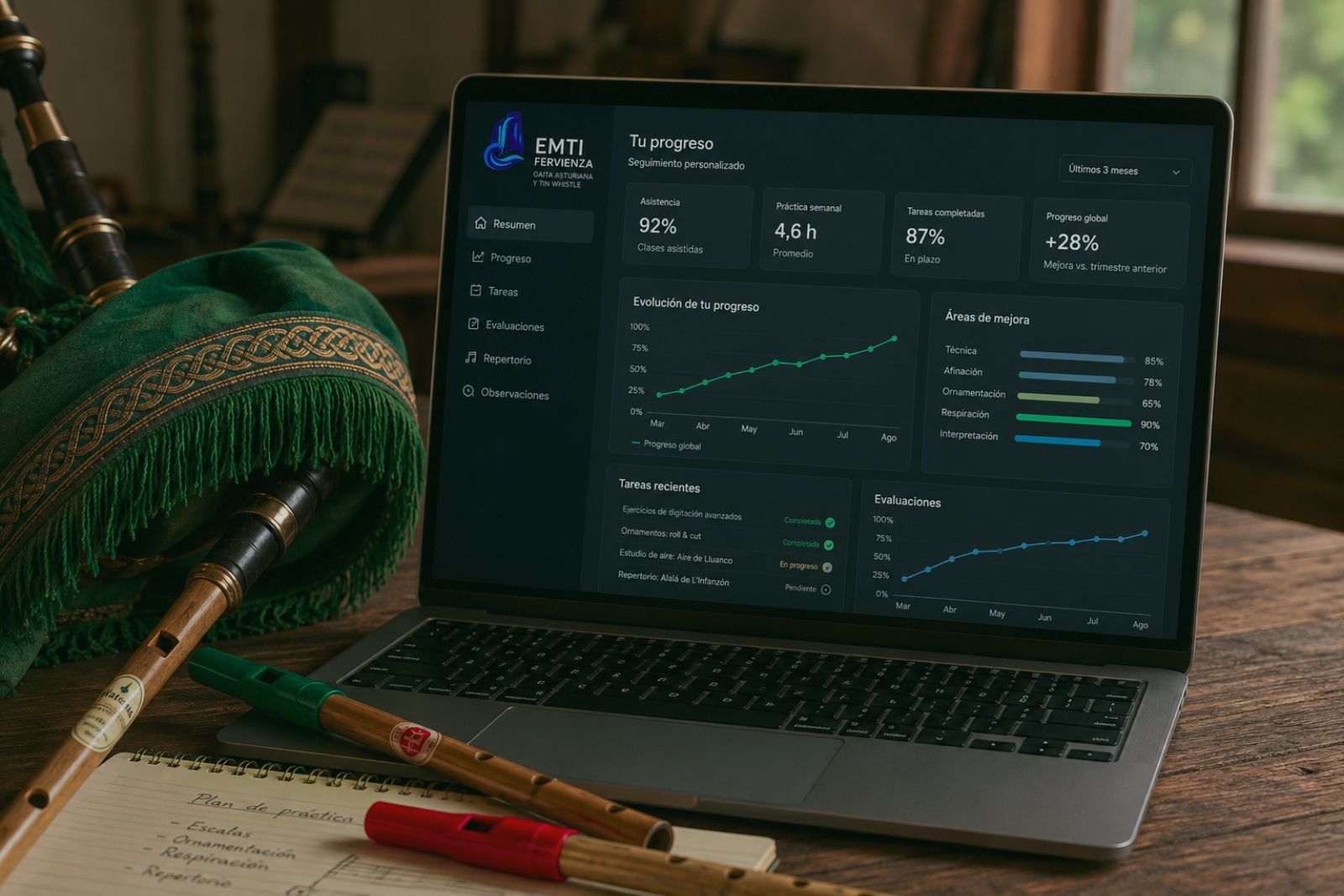
I’m Tever, piper and Asturian gaita teacher, and I’ve been running three projects at once since this year: tever.es for music, labs.tever.es for research in music informatics, and EMTI Fervienza — Escuela de Música Tradicional e Innovación (School of Traditional Music and Innovation), my online school for Asturian gaita and tin whistle (the world-famous Irish flute, also part of the programme) — for teaching. All three faces live in the same person — musician, researcher, teacher — which is why I write about my school here too, not only on its own domain: what I do teaching Asturian gaita and tin whistle comes from the same head that composes and researches. I already told the story of how the name came about back in August. Now it’s time to explain how we work.
Why I designed it this way
When I thought through the EMTI Fervienza model, I knew what I didn’t want: for the pace of learning to depend on my availability and the student’s lining up in the same weekly slot. It’s not that I don’t value live class — it’s that I wanted to sustain individual attention a different way, without a scheduling mismatch becoming the barrier to entry.
The model has four pieces:
- The lesson is delivered recorded, not live. Each student watches it whenever they can, repeats it if needed, pauses it to try something on the punteru — the part of the Asturian gaita played with the fingers to produce the melody — or on the tin whistle before moving on.
- A proprietary platform verifies that learning is actually happening. It isn’t free-form review: the system monitors the performance live while you play and measures real progress, not just whether the video was watched. It never records audio or video of the student: the measurement happens in the moment.
- Questions get answered with videos I record myself, built from what each student actually asks. It isn’t a generic answer prepared in advance: I respond to something specific someone has asked. And those videos stay available to the whole student body, not just the person who asked — it’s very likely someone else has the same question, so the video ends up useful beyond the one that triggered it.
- The first contact is live, though. The initial assessment, free of charge, is the only stage with a real video call: it’s there to decide whether EMTI Fervienza is the right fit, not to teach the lesson itself.
Three proprietary pieces, one result
As far as I know, no other place teaching Asturian gaita or tin whistle today combines these three things at once, and all three point to the same place: students playing, not accumulating theory.
A method of my own. I didn’t adapt a method built for another instrument — I built it for the Asturian gaita and the tin whistle from scratch, with the same logic I already used teaching classes in Proaza and Teverga between 2017 and 2022, later crossed with technology.
Instruments made by the school itself. The Xibla — the flute I use for learning the Asturian gaita — and the tin whistle I use in lessons are both made by EMTI Fervienza, in my own workshop. Anyone starting from scratch doesn’t depend on finding a suitable instrument on their own: the Xibla or the tin whistle is included in enrolment. If you already have your own instrument — including an Asturian gaita — we work with that. I supply and make the instrument for our lessons thanks to the experience built up since my first CHALGA 3D lutherie workshop.
A proprietary tracking platform. The same one that verifies learning and powers the video tutorials: it isn’t an add-on, it’s the backbone that lets the asynchronous model work without losing individual attention.
The concrete result is that students play accompanied from the very beginning: over backing tracks I record myself, with other instruments already in place, each student plays their own part on top. What we’re after is letting them feel the full experience of being a musician and playing with other instruments from minute one.
That combination — method, instrument and tracking, all three proprietary — answers something I already laid out when I went over where the conservatory and the Asturian gaita schools stand today: formal training has come a long way in two decades, but it still leaves out anyone without a conservatory or a band school nearby, or anyone who wants to learn at their own pace without depending on a place.
October, and a door that never closes
The course starts in October 2026. But enrolment doesn’t close that month: it stays open all year. October is the course’s starting point, not a deadline to sign up — whoever arrives in January or in June gets the same free initial assessment and the same model, without waiting for the next intake. If you want to request it, write to me at hola@emtifervienza.com.
The learning method we apply at EMTI Fervienza is the result of almost 30 years of my own work with the Asturian gaita and traditional music. After all this time, I believe the most important thing when learning an instrument is reaching autonomy: being able to play the pieces you know, whenever and wherever you want.