Essay · Musical Learning
The photo that named the school
I thought I already knew everything my family name meant. While researching a piece on the musicians of the valley, I found a photo that changed my mind — and ended up naming something I had just founded.
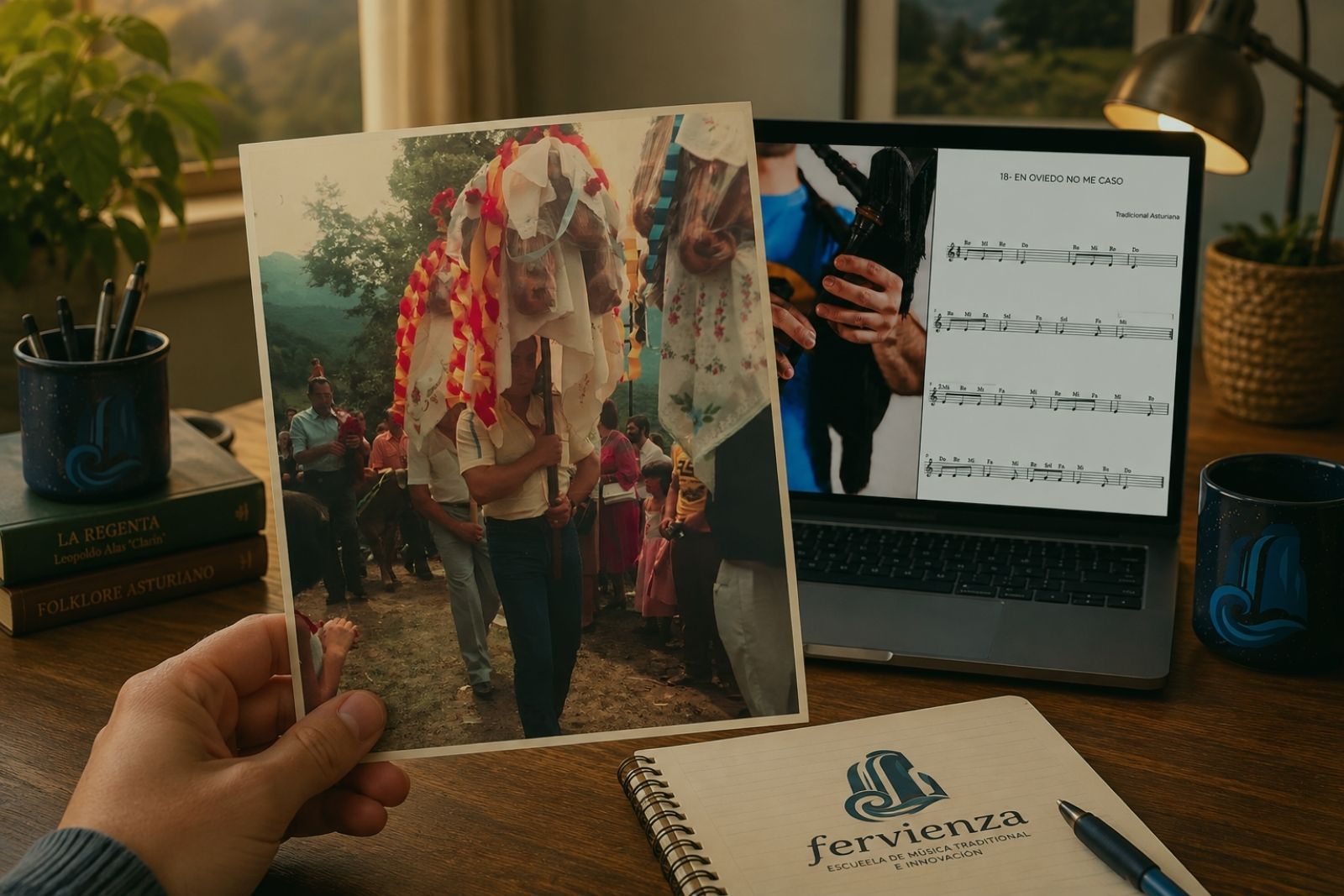
There are words you think you know completely, until you find the photo that explains them. It happened to me this year with “Fervienza”, my father’s second surname — I don’t carry it myself, but it’s the family name that had already titled one of my pieces back in 2021. I thought I already knew everything it meant. I was wrong.
A piece on the musicians of the valley
I’ve spent a long time researching the traditional music of my area, Proaza and Teverga, for a project of my own — Músicos Populares de Proaza y Teverga (Popular Musicians of Proaza and Teverga) — which gathers testimonies, photographs and oral memory from gaiteros, drummers and singers of the valley. It’s the kind of work that moves slowly: a conversation with an elder from the village, a family archive someone lets you look through, an undated photo you have to place by asking around.
In one of those archives a photo turned up from the 1980s, from the fiesta del Cébrano, in Teverga — the same offering to the Virgen de Carrea that my family has kept up from Sobrevilla, carrying the ramu on foot all the way there. And in it, carrying one of the ramos, was my father. Right beside him, the gaiteru Juan Huerta.
I already knew the tradition from home: I’ve watched it since I was a child. What I didn’t know was that this particular photo existed, or that my father had carried the ramu right next to a gaiteru, years before I was born. I had spent a long time thinking my bond with the Asturian gaita was my own choice, something I started at 13 almost out of curiosity. The photo told me a different story: that the gaita had already sounded next to my father, within that same tradition, before I ever went looking for it.
What the word means
Fervienza has a second meaning that also clicked into place once I put the pieces together. It comes from the Latin fervere — to boil — and names a waterfall, a cascade with foam. A surname that’s also a natural phenomenon: something that falls, that moves, that never sits still.
That double sense — lineage and waterfall — is the one I used in 2021 to title Fervienza, the three-movement piece on my album Fechu’n PLA, written about family loss and motherhood. I already told that story elsewhere: how that piece was born out of the need to narrate grief and continuity, not from an abstract musical idea. What I didn’t know back then is that the surname giving it its title also had a photo waiting to be found.
Thirteen years of gaita, a conservatory and a rural classroom
I started playing the Asturian gaita at 13. I played with the band Camín de Fierro, taught classes in Proaza and Teverga between 2017 and 2022, and later went through the Conservatorio de Oviedo. I’ve stood on both sides of the classroom: as a student who starts out not even knowing how to hold the punteru, and as a teacher watching a kid repeat the same clumsy gesture I made at that age.
That double experience — formal training and the village class, the conservatory and the rural classroom — is the ground EMTI Fervienza grows out of. Formal Asturian gaita education has come a long way in two decades, as I laid out when I went over where the conservatory and the schools stand today; but there are still students with no conservatory or band school nearby, or who simply want to learn at their own pace, without depending on a place or an entrance exam.
This isn’t the first time I’ve crossed tradition and technology to teach or to play, either: in 2011, my final degree project was a system that compared what you played on a real Asturian gaita against a reference score, to check your playing while you practised. The press dubbed it “Gaita Hero”, but it wasn’t a game: it was real gaita, with a real score. The idea that the technological tool serves tradition, not the other way round, comes from there.
EMTI Fervienza
EMTI Fervienza — Escuela de Música Tradicional e Innovación Fervienza (School of Traditional Music and Innovation Fervienza) — is an online school for Asturian gaita and tin whistle, with one-to-one lessons and no entrance exams. I teach through my own platform, built so that learning doesn’t depend on living near a conservatory or fitting into a municipal school’s calendar.
The photo chose the name, not the other way round. It’s called Fervienza because, long before I put it in a title, that surname was already at the fiesta del Cébrano, next to a gaiteru, carried by my father.
With this, my work is now split across three sibling projects, each with its own purpose: tever.es for music and outreach, labs.tever.es for research in music informatics, and now EMTI Fervienza for teaching. Three legs, and one of them carries my father’s surname.
Bibliography
- La Señora del Cébrano (Guía cultural, espiritual y turística del Santuario mariano de la Virgen del Cébrano). Colección «Xana de Fonfría», volume IV. Consejería de Cultura del Principado de Asturias, 2000. Reference guide to the sanctuary and to the tradition of offering to the Virgen del Cébrano that my family has kept up from Sobrevilla.
- Menéndez de la Torre, Herminia and Quintana Loché, Eduardo. «Las ofrendas de Ramos en Asturias». Revista de Folklore, Fundación Joaquín Díaz, no. 274, 2003, pp. 116-124. Reference study on the origin and the regional variants of the ramu tradition in Asturias, documented since 1522.
Frequently asked questions
-
What is EMTI Fervienza?
EMTI Fervienza —Escuela de Música Tradicional e Innovación Fervienza (School of Traditional Music and Innovation Fervienza)— is the online school for Asturian gaita and tin whistle I founded in 2026. I teach live individual and group classes, with no entrance exams, designed for anyone who wants to learn without depending on living near a conservatory or music school. The course starts in September 2026.
It’s the third strand of my work, alongside tever.es (music and outreach) and labs.tever.es (research in computer music): the one devoted to teaching. More at emtifervienza.com.
-
What is the ramu offering in Asturias?
The ramu (or ramo) is a festive offering carried in procession to the church on the day of a patron saint’s fiesta, as thanks or as a fulfilled promise to a local saint or Virgin — each village has its own: San Antonio in Cangas de Onís, San Acisclo in Pendueles, the Virgen del Acebo in Cangas del Narcea, among others. The tradition is documented in Asturias at least since 1522, at the romería of San Romano de Villanueva (council of Santo Adriano), and it’s still practised today in many councils.