Essay · Original Composition
Composing from the root: when music is the family name
Why composing for the Asturian gaita is, before anything technical, an act of identity: the story of Fervienza, the piece that was born from my family surname and from the need to connect those who are here with those who are gone.
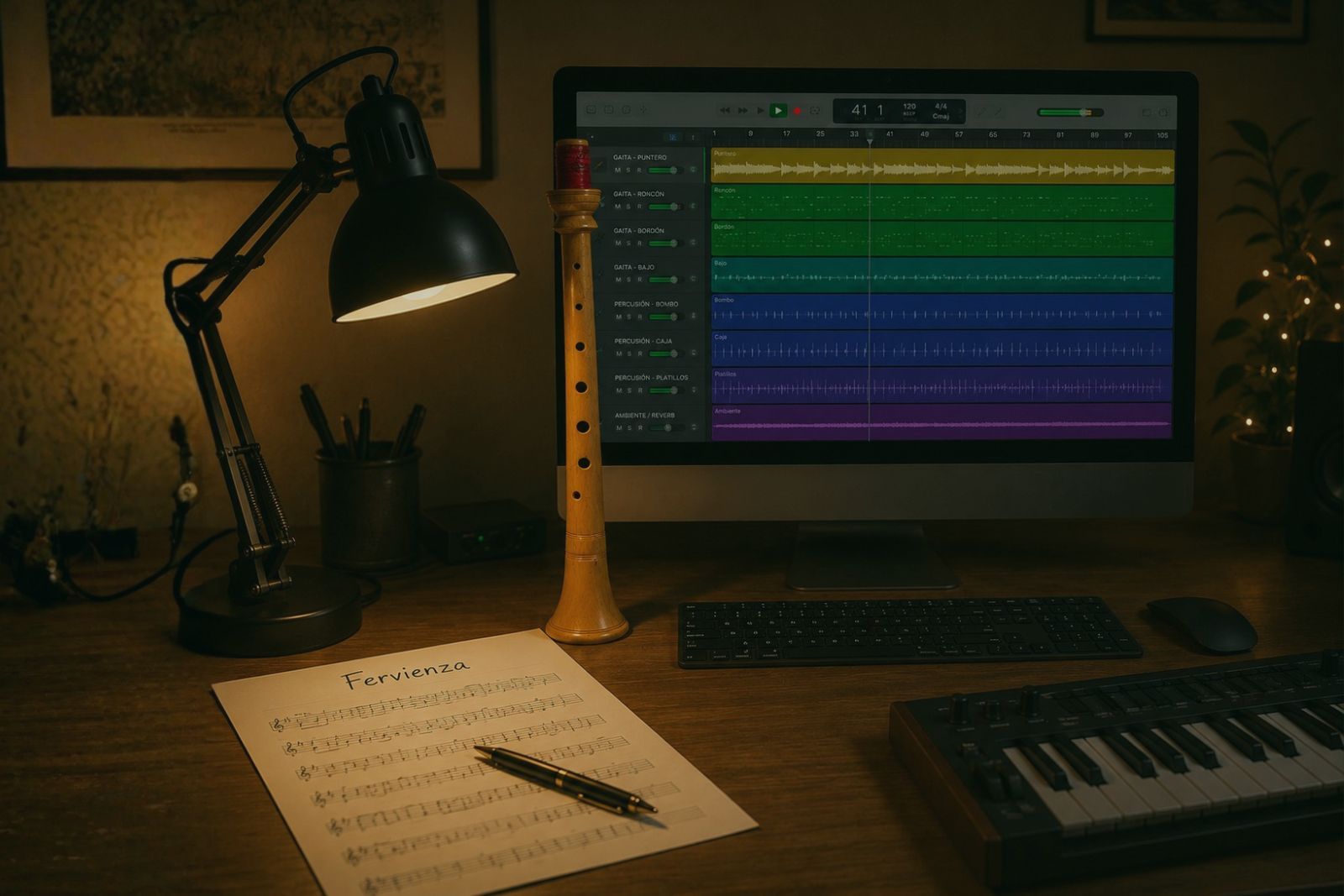
I don’t start from zero. I come with centuries of inheritance at my back: my music doesn’t come from a score, but from a commitment to the community, to the village, to what that village needs at any given moment.
My profession has a strange duality. I’m hired to build the “festival day” in parishes and villages; I’m the one who provides the music at fiestas, at romerías, at baptisms. But I’m also the one who scores the most absolute silence. Everyone has that film image in their mind — the Scottish piper playing Amazing Grace at a funeral —a tradition with a concrete history behind it. In Asturias, that role isn’t a scene from a film: it’s a real responsibility, raw and deep.
So when people ask me how I compose, I don’t talk about notes. I talk about identity. I talk about Fervienza.
The weight of a word
Fervienza is my father’s surname. It’s the name by which my family was known in the village. For me, that word isn’t a collection of letters: it’s the exact synonym for “family”. Composing this piece wasn’t a musical whim — it was the need to narrate an emotional journey through my own life story. That same surname, years later, gave my school its name.
I wasn’t looking for a pretty melody; I was looking to translate three stages of maturity that have marked us deeply.
1. Childhood: playing in the meadow
The piece opens with the light of childhood. That part of life where the gaita sounds like celebration without shadows. It represents play, discovery and the protection of those who came before us. The music is vibrant, reflecting the natural joy of someone who hasn’t yet had to say goodbye to anyone.
2. Youth: the blow and the grief
But life, like the music of the gaita, also has its tensions and its dissonances. My youth was marked by the harshness of loss. We lost many family members, among them my father. It was a dry, difficult process — one that changes the way you blow and the way you understand the instrument.
Musically, this section of Fervienza is a passage through suffering. It isn’t drawing-room sadness; it’s the real pain of watching the pillars of your house fall one by one. Here the music doesn’t seek to please — it seeks to hold the weight of those who are no longer here.
3. Maturity: becoming the root
The final section of the piece is the catharsis. My brother, my cousins and I went from being the children to being the parents. It fell to us to take on adulthood, to carry the legacy forward and to understand that the family continues even as its shape changes.
This musical phase is the most complex: it’s hard because it’s born of pain, but above all it’s full of hope. It’s the sound of continuing to grow, of continuing with the family, of continuing to be Fervienza. It’s the music that tells you that, despite everything, the roncón keeps sounding and we keep walking.
In the studio, this section needed the most layers. The main gaita carries two tracks of itself slightly out of sync — a tenth of a second apart — so that it sounds like voices searching for each other. It was the way to say in production what the notes alone couldn’t reach: that two generations are trying to find one another.
Listen
Closing the circle
In the music video for this piece, my journey ends at the cemetery of our village. My grandparents and my parents are there. The final gesture is simple, but it sums up why I am a piper: I leave them a photograph of their grandchildren — the ones they never got to meet.
That is the bridge. Music serves to connect those who are here with those who are gone. Composing isn’t putting notes in order; it’s finding the way for my ancestors and my children to reach across to each other through a punteru.
In the end, when I play at a parish fiesta or at a neighbour’s funeral, I do it with the same honesty with which I wrote this piece. Because in traditional gaita, if there’s no truth and no memory, there’s nothing left but air.
If you want to see the compositional process from the technical side, in Writing new music from tradition I break down how I work the musical material before it reaches the studio. And if you want to hear what the result sounds like in the first piece I released, it’s in «Suañu de Gaita». To see how this way of understanding tradition applies to a choral project, in Ramu Nadal I describe how I reinterpreted two pieces from Torner’s songbook with the same honesty. And when those inner rules belong to a completely different tradition —the clave and tumbao of Cuban salsa— the same principle is put to the test in The Asturian Anthem in salsa clave.
Bibliography
- “Fervienza” music video on YouTube: youtu.be/kKn3qtHhS_0. The piece this article is about; it is better understood heard than read.
- Torner, Eduardo Martínez. Cancionero musical de la lírica popular asturiana. Centro de Estudios Históricos, 1920. The repository of tradition on which writing from the root is built.
Frequently asked questions
-
What role does the gaitero play at Asturian funerals?
In Asturias, the gaitero isn’t only the one who livens up village festivals: they’re also the one who provides the music at the moments of deepest silence. Playing at a funeral is a real and profound responsibility, different from the decorative role the instrument has in films. The sound of the gaita —powerful, raw— lets grief have a voice without words.
This festival/funeral duality is one of the marks of the trade, and a defining part of how I understand the instrument.
-
Why does Tever compose from the Asturian tradition?
For me, composing is not a technical process but an act of identity. The Asturian gaita —its scale, its breathing, the relationship between punteru and roncón— is the language in which I think musically. Composing from the root means knowing that language deeply enough to say something of your own in it, not to repeat it.
A tradition that only repeats itself fades out; one that keeps generating new work stays alive.
-
What is Fervienza and why did Tever compose it?
Fervienza is my family’s surname and the name of an original composition for gaita asturiana narrating an emotional journey in three movements: childhood (play and protection), youth (loss and grief), and maturity (taking on the legacy and continuing).
The piece didn’t grow from a musical search but from the need to tell a family’s story through three vital states. In the final section, two gaita tracks slightly out of sync evoke two generations trying to find each other — the living and the dead, the present and the past, reaching toward the same note.
It’s the piece I’m most often asked to explain. But it’s really one you have to hear.
-
What is Fervienza?
Fervienza is my paternal family’s surname and the name of an original composition for gaita asturiana. The title isn’t a musical caprice: it’s the exact word for “family” in my most personal dictionary.
The piece narrates an emotional journey through three vital states — childhood, grief, and maturity — and has a music video with a final scene at the village cemetery, where I leave a photo of my children for the grandparents who never got to meet them.
It’s not a piece you explain easily. It’s one you have to hear.