Essay · Musical Learning
The payuela, the soul of the Asturian gaita
Why the Asturian gaita's payuela has the length it has, explained from Pelayo Fernández's 2014 analysis, with the real case of the C punteru. And why making and fitting your own payuela was, for generations, a skill as necessary as playing itself.
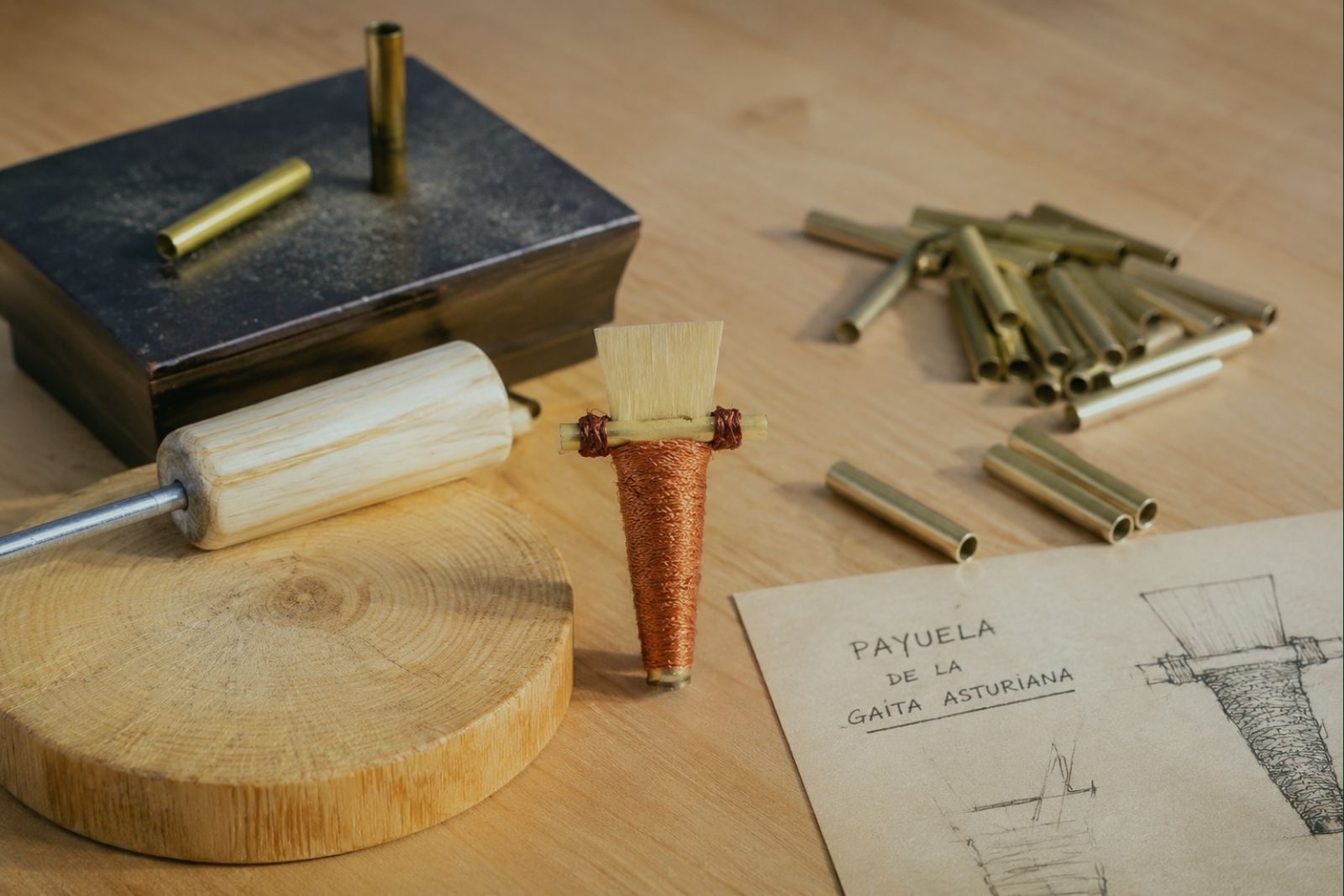
When someone searches “Asturian gaita payuela” online, they’re almost always looking for where to buy one or how to fit it. There’s a prior question almost nobody asks, and it has an exact answer: why is the payuela the length it is? It isn’t a matter of taste, or a tradition with no further explanation. It’s physics, and there’s a real analysis that proves it: Pelayo Fernández’s, published in 2014 through lagaita.com / Conceyu de la Gaita, which answers this question with data, not intuition.
If you’re not yet clear on which piece is which, start with what the Asturian gaita is. Here I focus on the relationship between two specific parts: the punteru and the payuela, the double reed housed in its upper end.
The payuela is, in a sense, the soul of the instrument: if it isn’t well fitted, it’s very hard for the gaita to sound good, however good the rest of the build is. And there’s no universal payuela: every gaita in the world has its own, specialised to its own specific design — the analysis below explains why it has to be that way.
The punteru isn’t a complete cone
A conical tube has a simple property: its fundamental frequency depends directly on its length. The longer it is, the lower it sounds. That relationship lets you calculate, with the speed of sound in air as the only extra piece of data, what length a tube should have to produce a given note.
Applied to the Asturian gaita, the calculation fits reality surprisingly well: a C punteru measures around 330 mm, and the formula predicts almost exactly that length for that note. The same holds for the rest of the usual keys: B♭ (350 mm), C# (311 mm), D (296 mm). Real punteros match what the physics predicts.
But here’s the detail that changes everything: the real punteru isn’t a complete cone. It’s cut off at the top — truncated — so the payuela can be fitted into it. That “missing piece” doesn’t vanish from the equation: something has to complete it for the instrument to keep sounding in its proper key. That something is the payuela.
Physical length and acoustic length aren’t the same thing
This is the central idea of Pelayo’s analysis, and the one that answers the question in the title. Two different magnitudes need to be told apart:
- The physical length of the payuela: the one you measure with calipers or a ruler.
- The acoustic length: the one that corresponds, under the same conical-tube formula, to the note the payuela produces when you blow it on its own, outside the punteru.
The payuela, as an isolated piece, also sounds a specific note when blown. That note has its own associated wavelength — its acoustic length — and that’s the magnitude that actually matters for the calculation, not the physical size of the cane.
The real case: the C punteru
The analysis itself verifies this with a concrete example, and it’s the clearest way to see this isn’t just theory.
A C punteru measures, in practice, around 330 mm of real tube. For that punteru to produce the note C with every hole covered, the payuela — blown on its own, outside the tube — has to produce roughly the note B plus 50 cents (around 2012 Hz). It’s a figure you can check with an ordinary tuner, by blowing the C reed on its own.
That frequency corresponds to an acoustic length of around 85 mm. Adding the real tube (330 mm) to what the payuela contributes (85 mm) gives an effective length of 415 mm. And here’s the check that closes the argument: a 415 mm tube, under the same formula, should produce the note A♭ (Ab) — not C.
A contradiction? No. What happens is that the 330 mm tube with no holes covered gives C; but when every hole on the punteru is covered — including the vent holes, and the right-hand little-finger hole — the actual note that comes out is exactly that A♭ predicted by the calculation. The formula holds.
The final check is the most compelling one: if you physically measure how much is missing from the real tube — from where it’s truncated up to the theoretical apex of the complete cone — you get a distance of around 82 mm. Practically identical to the 85 mm predicted by the acoustic calculation from the payuela’s note. Two different paths, the same result: the payuela measurably completes exactly what’s missing from the truncated tube.
The payuela within the tradition
This precision isn’t a modern discovery: traditional gaiteros already knew it in practice, even without explaining it through formulas. Making your own payuelas was part of the craft, and fitting one — scraping, testing, scraping again — was learned through time, not from a manual.
I have a concrete example of this from my own research: in an interview I did with the daughter of Juan Huerta — the gaiteru who appears next to my father in the photo that named EMTI Fervienza — she told me her father used to sand payuelas at his own workplace, where he worked as a caretaker at an electricity company in Oviedo. It’s a manual process, and getting the fit right takes time; he did it in the spare moments he had, between one task and another during his workday.
It’s not an isolated anecdote. A traditional gaitero had to be self-sufficient with their instrument: anyone living far away, in the mountains, with nobody nearby who could hand them a replacement part if something failed, had to know how to fix their own gaita. Fitting the payuela was, for that generation, a skill as necessary as playing.
Why this matters beyond curiosity
This relationship explains things that, if you don’t know it, look like plain tradition or coincidence: why not just any payuela works with just any punteru, why changing key means changing the payuela and not just the tube, and why two punteros in the same key but of different builds can need slightly different payuelas to sound in tune. It isn’t a maker’s whim: it’s the same physics of the truncated cone, applied to each specific instrument.
The same double-reed logic appears in other bagpipes, each with its own dimensions and behaviour — I discuss it when comparing the Asturian gaita with the uilleann pipe — though each family resolves the truncated cone its own way.
Pelayo’s own analysis leaves several questions on the table that follow from this same logic, questions every gaitero has asked at some point: can you fit another gaita’s reed onto an Asturian one? Why, for the same key, do some punteros have a different length than others? Do one maker’s payuelas work in another maker’s punteru? The answers aren’t universal — they depend on each specific build — but they all stem from this same relationship between physical length and acoustic length.
Bibliography
- Fernández, Pelayo. Punteru y payuela ¿son un todo o son dos partes? lagaita.com / Conceyu de la Gaita, 2014. Source of the acoustic analysis and the practical case of the C punteru that structures this article.
- Fernández Velasco, Alberto. La gaita asturiana: historia, técnica y repertorio. Caja de Ahorros de Asturias, 1991. Background reference on the construction of the punteru and the reed.
- Baines, Anthony. Bagpipes. Oxford University Press, 1960. Comparative context on the double reed across European bagpipes.
Frequently asked questions
-
Does one maker's payuela work on another maker's gaita?
Not always, and for a physical reason, not one of quality or brand. Two punteros can share a nominal key — both in C, say — and still have slightly different builds between them: variations in interior reaming, diameter, or the exact point where the tube is truncated. The payuela has to match the specific acoustic length of that specific tube, not just “the key” in the abstract. That’s why a payuela that fits one punteru perfectly can respond differently — or outright poorly — on another of the same key made by a different maker. It isn’t an absolute rule: plenty of payuelas are interchangeable between similar gaitas, but there’s no automatic guarantee just from sharing a key.
-
Why is the payuela the length it is?
Because the real punteru isn’t a complete cone: it’s truncated at the top so the payuela can be fitted into it, and that piece has to acoustically “complete” the part missing from the tube. In the case of the C punteru, the real tube measures around 330 mm, and the payuela contributes an acoustic length of around 85 mm — not a physical measurement, but the one corresponding to the note the payuela produces when blown on its own — adding up to the 415 mm the cone formula predicts for the note that comes out with every hole covered. It isn’t a measurement decided by tradition or taste: it’s a physical relationship you can verify with a tuner.