Essay · Original Composition
Writing new music from tradition
How I compose starting from Asturian tradition without limiting myself to repeating it. My real process, the blend of root and contemporary, and why I believe this is how it stays alive.
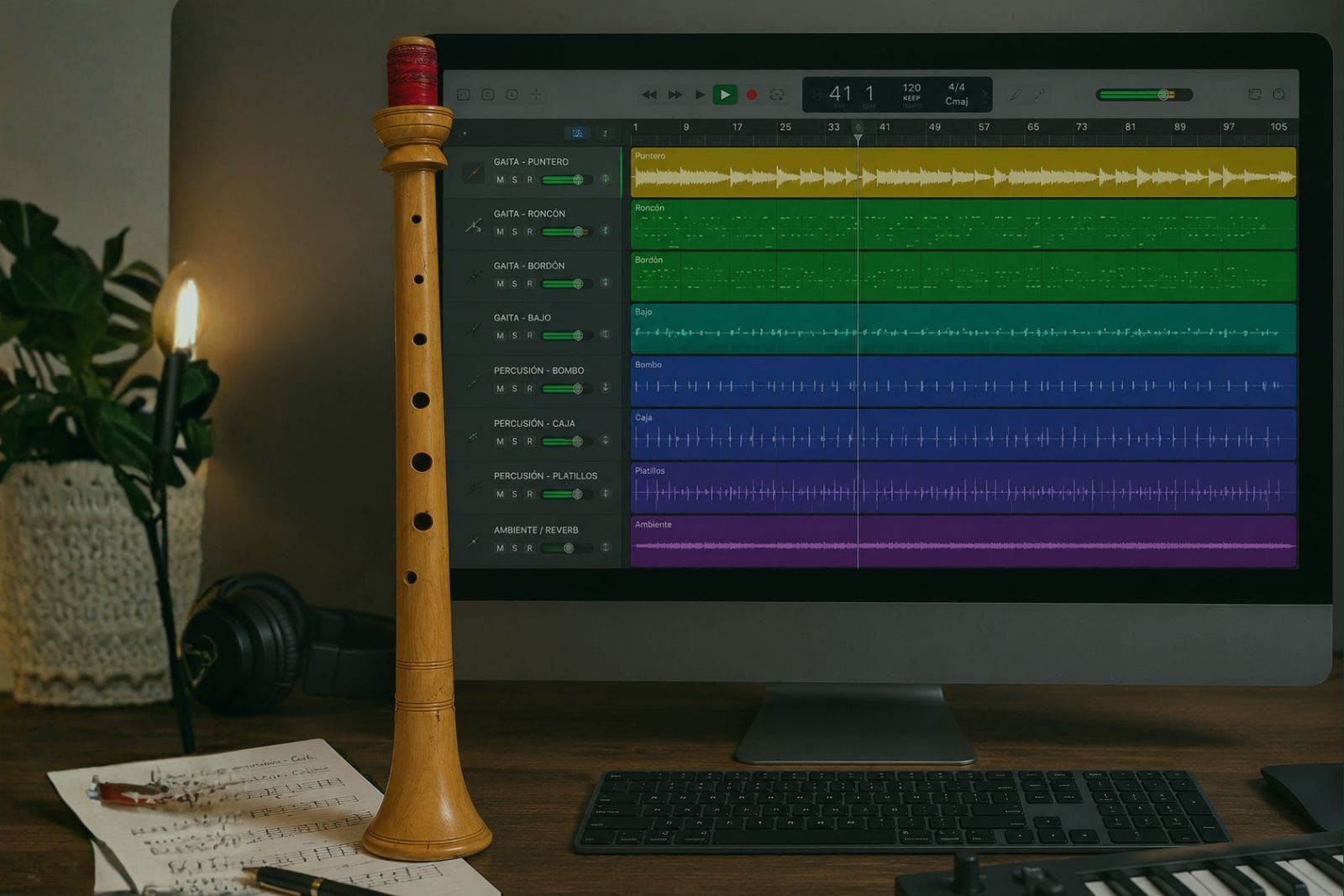
I compose starting from the tradition of the Asturian gaita, but not to repeat it: to write new music with it. The root is the starting point, not the destination. In this essay I tell you how I actually do it —the process, not the theory— and why I believe it’s the best way to keep the tradition alive.
I grew up playing the inherited repertoire and I’ve never let go of it. But playing what I was given and composing are two different gestures, and this text is about the second.
Playing the tradition and composing are not the same
When I play an alborada or a march, I’m serving a piece that already exists: I tend to it, I respect it, I make it sound as good as I can. When I compose, I do something else. I take the language of the Asturian gaita —its scale, its way of breathing, the relationship between punteru and bordón— and I write something that wasn’t there before.
The usual confusion is to think that composing “from the root” means imitating the old or dressing up the new as old. It doesn’t. It means knowing the tradition so thoroughly that you can say something of your own in its language.
My process, no mystery
I don’t have a textbook method, but I do have an order that repeats.
- I start from the instrument, not the abstract idea. I pick up the gaita and play until a turn of phrase appears that I hadn’t heard before. The Asturian gaita has a particular way of moving —what the punteru allows, what the bordón sustains— and almost always the idea is born there, from the hand, not the head.
- I let the tradition set the rules… and then I stretch them. If a piece asks for a dance metre, I respect it for a while and then shift it on purpose. The interest lies in the tension between what’s expected and what breaks the expectation.
- I test in production. This is where the technologist side comes in: I record, I layer, I listen to the gaita alongside textures that aren’t traditional. Not to “modernise” it as ornament, but to hear what holds and what’s surplus. Almost always something is surplus. The technical process behind this —what a DAW is, what phases production has, how I did it with Logic Pro X— I tell in Producing with a DAW as a musician.
- I take away. The last phase is subtraction. A piece is finished when I can no longer remove anything without it falling apart.
The blend is not decoration
I’m a gaitero and I also work with contemporary production tools. I don’t experience that as two worlds: it’s a single one. The gaita next to careful sound design isn’t a concession to fashion; it’s carrying on what traditional music always did, which is to absorb what’s around it and still be itself.
What I don’t do is off-the-shelf folk fusion or generic world music, where the origin dilutes until it becomes scenery. My root is Asturian and I want it to show where each thing comes from. For the blend to be worth anything, it has to start from something firm.
Why tradition is preserved by creating
Some defend tradition by putting it behind glass: always playing it the same way, freezing it, treating it as a museum piece. I believe the opposite. A tradition that only repeats itself fades out slowly. One that keeps generating new work stays alive.
Asturian traditional music reached me because earlier generations didn’t limit themselves to copying: they played, they changed, they added. Composing from the root is returning that gesture. I don’t betray what I inherited by writing new things; I continue it. Sometimes that gesture starts from collected material rather than invented —as in «Ramu Nadal», where I reinterpreted two aguilandos from Torner’s songbook to accompany an Asturian Christmas tradition.
A concrete piece
All of this sounds better with an example than with a statement. «Suañu de Gaita» is my way of saying this in music: a piece where the Asturian gaita dreams a little without ceasing to sound like it’s from here. I tell the story, with a link to listen, in «Suañu de Gaita»: composing from the root. And if you want to see how that same process, when it starts from personal history and family grief, produces something very different in tone but identical in root, it is in Composing from the root: when music is the family name.
Questions I get asked
What is composing from the root? Writing new music by taking the tradition of the Asturian gaita as a starting point —its scale, its breathing, its punteru-bordón relationship— and not as a destination. Knowing the language thoroughly in order to say something of your own in it.
Is it the same as fusion? No. Off-the-shelf folk fusion and generic world music dilute the origin until it becomes scenery. Here the Asturian root is firm and recognisable: the blend starts from it, it doesn’t replace it.
Does composing instead of repeating betray the tradition? On the contrary. A tradition that only repeats itself fades out slowly; one that keeps generating new work stays alive. Composing from the root is continuing the gesture, not breaking it.
If I had to sum it up in one sentence: I don’t compose despite the tradition or on top of the tradition, but from it.
Bibliography
- Torner, Eduardo Martínez. Cancionero musical de la lírica popular asturiana. Centro de Estudios Históricos, 1920. The songbook that composition from the root starts from.
- Nettl, Bruno. In the Course of Performance: Studies in the World of Musical Improvisation. University of Chicago Press, 1998. On how oral tradition is transmitted and transformed; a framework for understanding the difference between repeating and composing.
Frequently asked questions
-
What does composing from the root mean?
It means writing new music taking the tradition of the gaita asturiana as a starting point — its scale, its way of breathing, the relationship between punteru and roncón — and not as a destination.
It’s not imitating the old, or disguising the new as ancient: it’s knowing the tradition deeply enough to say something of your own in its language. You’re not trying to sound old. You’re working from an understanding of the roots so solid that what comes out is genuinely yours — and still recognizably from here.
The root produces new fruit every year without ceasing to be the same root.
I go into this at length in Writing new music from within the tradition.
-
What is the difference between composing from tradition and doing folk fusion?
Catalogue folk fusion dilutes the origin until it becomes decoration: the gaita asturiana sounds in the background, but the root has evaporated. What you’re left with is atmosphere, not identity.
Composing from the root starts from the opposite position: the Asturian identity is firm and recognizable, and any blending with contemporary elements comes out of it — doesn’t replace it. The tradition is the source, not the backdrop.
If you can’t hear where the root comes from, the blending doesn’t hold.
I lay this out in detail in Writing new music from within the tradition.
-
Does composing new pieces betray musical tradition?
On the contrary. A tradition that only repeats itself fades out slowly; one that keeps generating new work stays alive. Asturian traditional music has reached today because each generation absorbed what it had to hand and kept being itself. Treating tradition as a display case —always playing it the same way, freezing it— is the surest way to kill it slowly. Composing from the root is returning that gesture: continuing, not breaking.