Guide · Musical Learning
How many notes does the Asturian bagpipe have? From traditional roots to chromatic chanter
The Asturian bagpipe doesn't start where most people expect: its note map begins on the low B and climbs all the way up to the requintu F. A journey from the diatonic scale of its roots to the chromatic chanter studied today at the Conservatorio Superior.
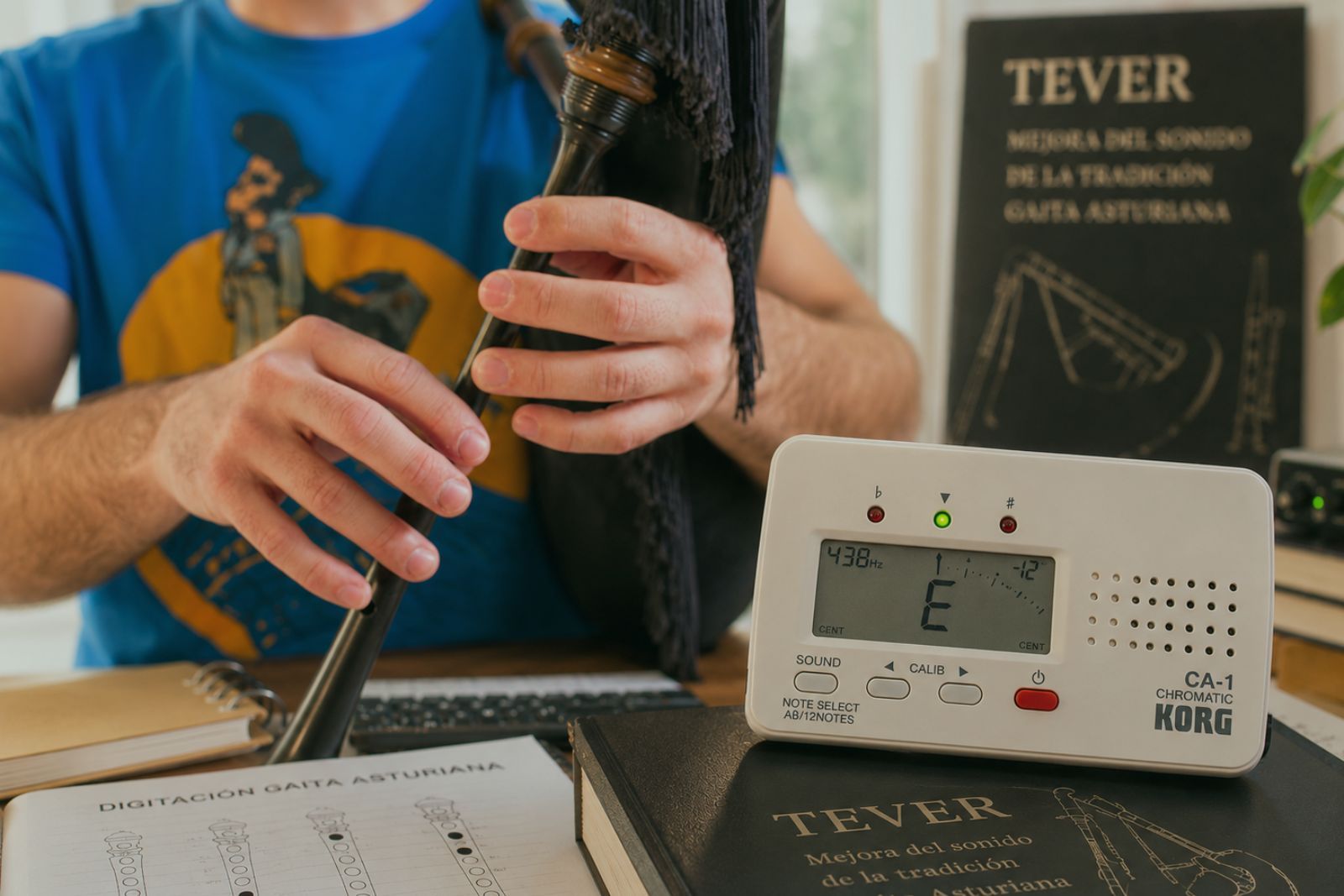
The Asturian gaita has 12 notes in its full map: 9 base notes and 3 requintu notes. That is what the standard punteru yields, taking C as the reference key. And they start where many people don’t expect: not on C, but on the low B.
If you are used to listening to music on the radio or looking at piano keys, the gaita asturiana will upend your expectations from the very first second. The first thing that strikes you is its brightness: physically, the bagpipe’s timbre sits an octave above middle C on the piano. That is what gives it that sharp, piercing, vivid sound — designed to cut through the air and fill the plazas on feast days.
But the real revolution lies not only in its pitch, but in how its note map has evolved.
The real map of our notes
Contrary to what many people believe, the scale of a current gaita (taking C as the reference key) does not start on C. The journey begins one step back, on the low B, and climbs upwards with a surprisingly wide register.
To make sense of it, we pipers divide the instrument into two territories: the natural notes and the requintu (the highest notes, which differ from their lower counterparts in air pressure and fingering). This is the real map of what comes out of the punteru:
| Register | Notes |
|---|---|
| Base notes | Low B · C · D · E · F · G · A · B · C |
| The requintu | D requintu · E requintu · F requintu |
Reference key: C. Total: 12 notes (9 base + 3 requintu).
Moving from the lower register to the requintu is where craft shows itself. That requintu F is a cry of brilliance in today’s repertoire — a note that demands absolute precision in the bellows and reveals the instrument’s physical maturity.
From the drone’s necessity to shared music
Traditionally, the gaita asturiana was a strictly diatonic instrument — a scale with barely any semitones, save for occasional exceptions such as B♭ or E♭. This made complete sense in its origins: the chanter only needed to blend and tune against the roncón, which generates the continuous drone. It was a closed dialogue by nature.
However, when we pipers stepped out into the world and decided we wanted to play with bandas de gaites, with orchestras, with pianists at solemn celebrations or with guitars at folk festivals, the repertoire became too narrow. We needed to speak the same language as everyone else.
The equal temperament of the instrument opened the first door, but Asturian craftsmen went further: they began designing chromatic chanters.
The present is chromatic: the classroom’s endorsement
Thanks to advances in construction and modern technique, we now have chanters capable of executing the full chromatic scale, with all its semitones and accidentals within the tempered system.
This leap is no longer an experiment by a handful of makers: it is an established academic reality. At the Conservatorio Superior de Música de Oviedo, the next generation of professional bagpipers has been working directly with the chromatic gaita for years.
Oral transmission — from grandparents to grandchildren in the meadow — and the academy are not two separate stages: they are two contemporary ways of carrying the same instrument forward.
Tradition without chains
Making music today with the gaita asturiana is an honour because we enjoy the best of both worlds. We keep intact the emotional weight of our heritage — the one that lets us connect with neighbours in an alborada or accompany them with reverence at a funeral. But at the same time, we wield a modern, chromatic, tempered instrument that can stand face to face with any musician on the planet.
The gaita asturiana no longer just accompanies its own drone: it now speaks to the entire world.
If you want to understand the historical leap that made that dialogue possible, I tell the story in The evolution of our sound: how the Asturian bagpipe learned to play with the world.
Bibliography
- Fernández Velasco, Alberto. La gaita asturiana: historia, técnica y repertorio. Caja de Ahorros de Asturias, 1991. Description of the original diatonic range and of the evolution of the punteru.
- Conservatorio Superior de Música de Oviedo — Plan de estudios de gaita asturiana (vigente). Academic endorsement of the chromatic punteru as the standard of professional teaching.
Frequently asked questions
-
How many notes does the Asturian gaita have in total?
In C tuning, the gaita asturiana has 12 notes: 9 base notes plus 3 requintu notes (D, E, and F in the upper register). These 12 cover the natural diatonic range of the instrument.
With modern chromatic punteros, that map expands to cover the full equal-tempered scale — all semitones included — which is what the Oviedo Conservatory now teaches as standard.
I map out the full range and how each note is produced in How many notes does the Asturian gaita have?.
-
Is the Asturian gaita in C or B-flat?
Both are common. The gaita in C (Do) is the most widespread in Asturias and the standard reference for traditional repertoire — the one you hear at festivals, in bands, in most teaching contexts.
The gaita in B-flat (Si bemol) has a darker, warmer tone. It’s used mainly in religious ceremonies and is also the reference tuning across the Atlantic arc — Scottish pipe bands, Breton bagadou, and most Galician contexts. If you play with those traditions, B-flat is the common language.
I break down all three standard tunings and what each one opens up in How many notes does the Asturian gaita have?.
-
Can the Asturian gaita play in any key?
With a modern chromatic punteru, yes: it covers the full equal-tempered scale with all its semitones, making it possible to play in any key within that system.
The traditional diatonic gaita has a more limited range — it covers the natural scale of its built-in tuning without the intermediate semitones. That’s sufficient for the traditional Asturian repertoire, but it closes doors when playing with instruments from other musical systems.
Today the chromatic punteru is the standard taught at the Oviedo Conservatory. It extends the instrument’s reach without changing what it fundamentally is.
I map out the full range in How many notes does the Asturian gaita have?.
-
What is the difference between a diatonic and a chromatic Asturian gaita?
The traditional Asturian gaita was diatonic: it produced a scale with hardly any semitones, enough to accompany the roncón and play its own repertoire. The modern chromatic gaita, developed by Asturian craftsmen, can play the full tempered scale with all its semitones. That makes it compatible with any instrument or musical system. Today the chromatic punteru is the standard studied at the Conservatorio Superior de Música de Oviedo; it coexists with the traditional punteros depending on the context.
-
What is the requintu of the Asturian gaita?
The requintu is the upper register of the gaita asturiana’s punteru. These are the highest notes on the instrument — D, E, and F in the upper octave — obtained by increasing air pressure and adjusting the fingering relative to the base notes.
Playing cleanly up into the requintu is one of the markers of a gaitero’s technical maturity. It requires precise fol control — especially for the F requintu, which is the highest note of the instrument’s natural range and the most demanding to produce cleanly and stably.
I map out the full note range and how the requintu fits in How many notes does the Asturian gaita have?.
-
What is the requintu on the Asturian gaita?
The requintu is the three highest notes of the punteru: D, E, and F in the upper range. They’re produced with higher air pressure from the fol and different fingering from the main register.
Mastering them requires more bellows control than the base notes — the fol needs to be more active, more precise. The upper F is the highest note in the standard scale and the one that demands the greatest precision to produce cleanly.
Making the transition from the base register to the requintu without breaking or going sharp is where you see the gaitero’s craft. It’s where technique becomes visible.
I explain the full note map in How many notes does the Asturian gaita have?.