Essay · Original Composition
The Asturian Anthem in salsa clave
Why I took the Asturian Anthem to salsa rhythm for Asturias Day: what the Cuban clave has that a march doesn't, and what you have to accent —and what you have to break— to make a straight melody sound real in salsa.
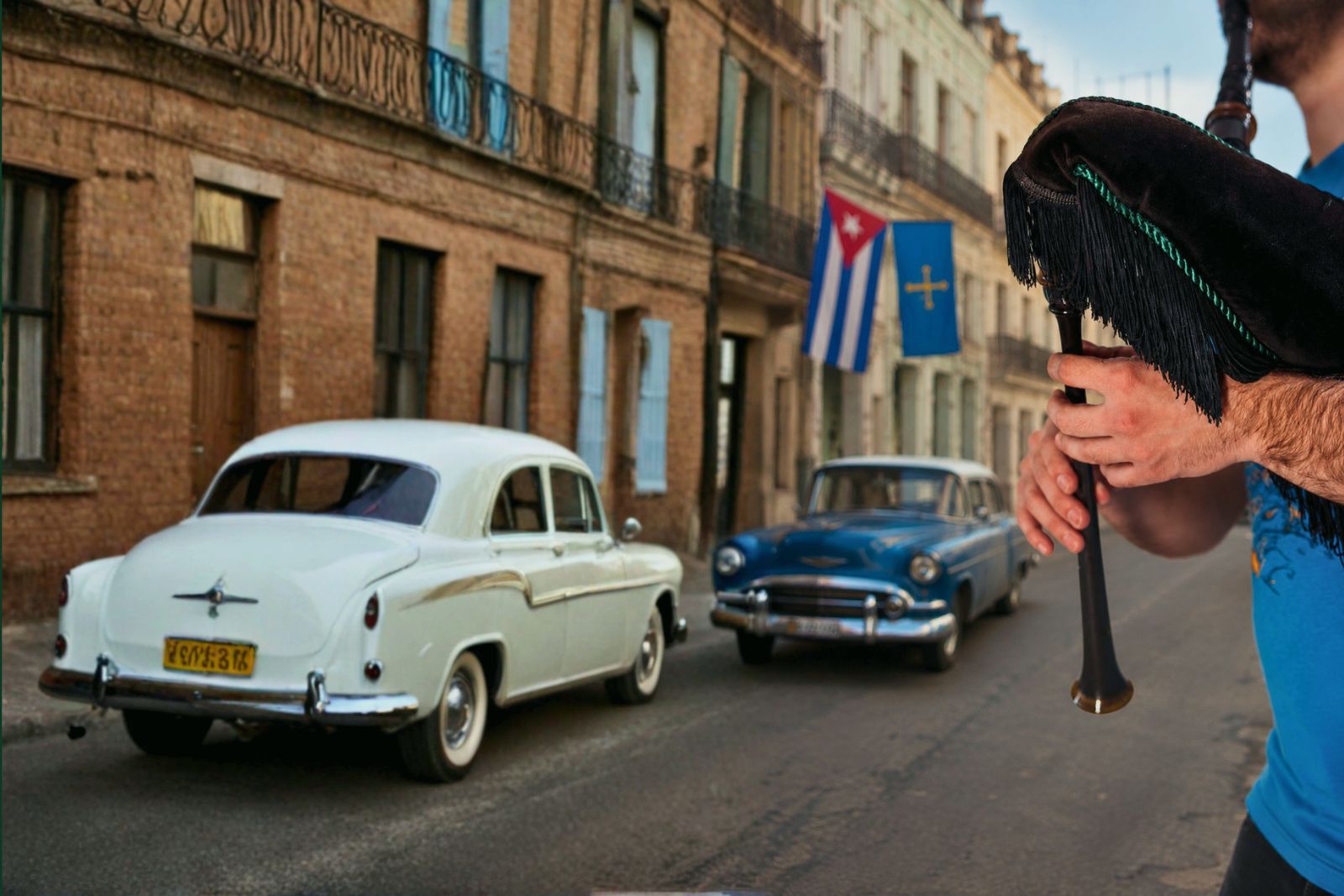
On September 8, 2024, Asturias Day, I released an arrangement of the Asturian Anthem in Cuban salsa rhythm. It’s not a joke or an occasional mashup: it’s a serious exercise in what happens when you take a straight, institutional melody, meant to sound solemn, and force it to move inside a rhythmic pattern that comes from a completely different place: Cuba, the son, the clave.
Why Asturias Day, and why salsa
The formality of the Asturian Anthem —march, steady tempo, straight phrasing— shows up mostly in gaita bands and official ceremonies. On the street, when people sing it at a party, it’s common to speed up the second part; there’s no written rule for that, but it’s not rare to hear it either. There’s no single, strict use of the Anthem, and I wanted to try something different for the date that’s supposed to celebrate it: make it sound Asturian and, at the same time, sound like something else entirely, without either side dissolving into the other. The Asturian gaita carrying the original melody, but over a rhythm that has nothing to do with its own tradition.
I produced the whole thing in a DAW, with the same approach I already told in Producing with a DAW as a musician: the gaita recorded, and the rest of the arrangement —piano, bass, Latin percussion— built in the session, with no live band.
The clave: the pattern that organizes everything else
The first thing you need to understand about salsa is the clave. It’s not a rhythmic decoration, it’s the structure that holds up the whole piece. It’s a two-bar pattern: one bar with three hits (the “3” side), another with two (the “2” side). Depending on which one comes first, it’s called 3-2 clave or 2-3 clave. The three-hit side is the tension side —triplet feel, syncopation, forward push—; the two-hit side is the resting side, where the phrase settles.
That clave isn’t always played explicitly by the claves (the percussion instrument the pattern is named after), but every other instrument has to be coordinated with it. If a piano or a bass plays “crossed” against the clave without that being a deliberate choice, the piece sounds wrong even if every note is played correctly. It’s a grammar, not a decoration.
Adapting the Anthem to this pattern meant deciding, phrase by phrase, which side of the clave each melodic motif fell on —and that alone completely changes how the original melody breathes.
The tumbao: why the bass doesn’t play where you’d expect
The salsa bass doesn’t play on the strong beats the way it would in a march or in almost any Central European music. It plays the tumbao: a syncopated pattern that, in its basic form, falls on the first beat, on the upbeat of the second beat, and on the fourth beat. The single most important hit of the whole pattern is that upbeat of the second beat —that’s where the bass usually anticipates the root of the coming chord, getting ahead of the rest of the group.
That anticipation is the hardest trait for a musician trained in straight phrasing to internalize —and an Asturian march is straight phrasing by the book—. The bass arrives “earlier” than the classically trained ear expects, and that sense of arriving early is exactly what makes salsa push forward instead of settling into the beat. It was the most costly adjustment in the whole arrangement: the Anthem’s melody wanted to settle on the strong beat, and the tumbao kept pushing it forward.
Which instrument does what
In a salsa lineup, each instrument has a fixed role:
| Instrument | Role |
|---|---|
| Piano | Montuno: a repeated, syncopated chord pattern, the harmonic-rhythmic backbone of the piece |
| Bass | Tumbao: the syncopated, anticipated line described above |
| Timbal | Bell pattern that drives the piece, equivalent to the role of a rhythm guitar |
| Congas | Supporting rhythmic base, holds the pulse underneath everything |
| Bongó | Free improvisation during the verses; switches to bell during the montuno |
| Horns | Short accents and occasional melodic reinforcement |
In my version, the Asturian gaita takes the place that would normally go to the horns or the voice: the lead melody, above the rhythmic web. The challenge wasn’t playing the melody —I already knew how to do that—, it was making that melody coexist with a tumbao that kept pushing it out of the spot where it “wanted” to land.
What I had to break in the Anthem
The original melody of the Asturian Anthem isn’t built to be syncopated: it’s a march, and marches resolve on the strong beat by design. To make it work in salsa I had to decide, motif by motif, where to delay or push forward a note relative to how it “should” sound on the original score, so it would fit the side of the clave that bar called for. It’s not a rule I can give you as a general formula —there’s no source that codifies “this is how you turn any anthem into salsa”—, it’s an arrangement decision made phrase by phrase, listening for whether the clave’s tension and resolution land where they need to land.
Playing with salsa’s rules opened up phrasings the original melody didn’t have and let me take the rhythm where I wanted. Making an arrangement is closer to shaping clay than to following a blueprint: you take the inherited material and bring it to the rhythm and taste you’re after, not the other way around.
That’s what, deep down, most resembles what I already tell in composing from the root: it’s not about forcing two traditions to fit together by brute force, it’s about truly understanding the internal rules of each one —the tuning and phrasing of the Asturian gaita on one side, the clave and the tumbao on the other— and letting both coexist without either one losing what makes it what it is.
Listen to it
→ Watch the Asturian Anthem in salsa version on YouTube
Bibliography
- Moore, Kevin. Understanding Clave and Clave Changes: Singing, Clapping and Dancing Exercises. Moore Music/Latin American Music Center, 2012. Reference monograph on the 3-2/2-3 clave pattern and its organizing function.
- «14.6 The 3–2 Son Clave». Puget Sound Music Theory, musictheory.pugetsound.edu. Technical analysis of the son clave pattern.
- Mauleón, Rebeca. Salsa Guidebook: For Piano and Ensemble. Sher Music Co., 1993. Reference manual on the typical instrumental roles of the salsa lineup (piano, bass, timbal, congas, bongó, horns) and the characteristic bass pattern (tumbao) of son/salsa.