Essay · Original Composition
Producing with a DAW as a musician: Logic Pro X, Suañu de Gaita and what I learned along the way
How I produced my EP Suañu de Gaita (2019-2021) with Logic Pro X: why I chose that DAW, and what the process taught me about myself. If you want to understand how music production works, I recommend reading this post.
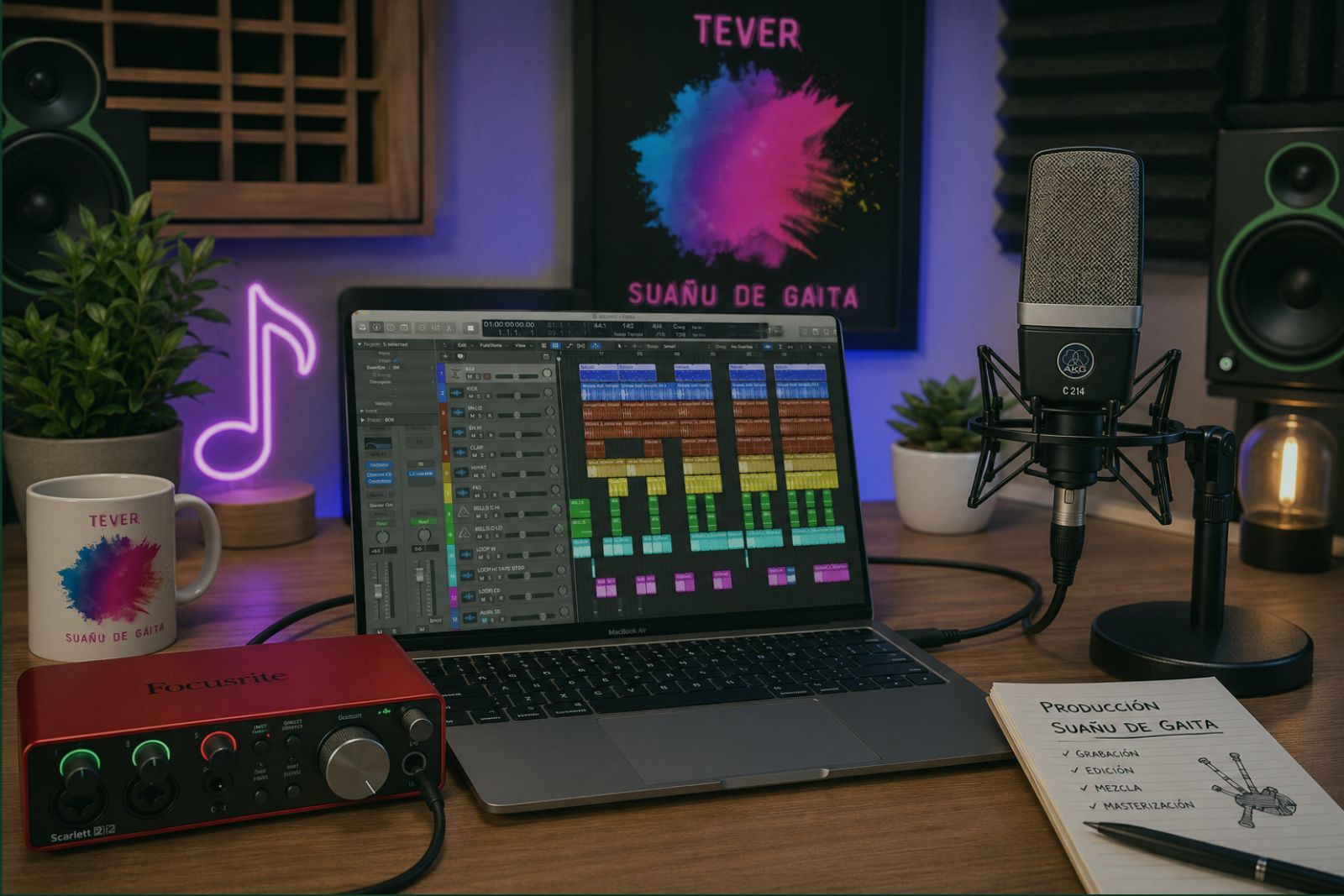
I produced my EP Suañu de Gaita (2019-2021) with Logic Pro X. When I trained with Alberto Rionda and Javi Rubio, I understood that the path ran through mastering that tool from the inside: not as a sound engineer, but as a musician who needs technology to stay out of the way between him and the music.
Producing is the process of turning a performance into a finished record. It has four main stages: recording (capturing the takes), editing (selecting and adjusting), mixing (balancing every element within the sound space) and mastering (preparing the final result for distribution). A DAW —Digital Audio Workstation— is the application that lets you digitise and manage that whole process: Logic Pro, Pro Tools, Ableton and the like are the environments where it all happens.
Why Logic Pro X
I came to Logic through the Mac ecosystem: clean integration, low latency, and above all, low friction. There are very powerful DAWs that force you to learn the software before you can make music. Logic flips that relationship: you can record on day one and edit seriously by the second week.
For a musician whose priority is the sound and not the manual, that is no small thing. Logic’s advantage is not being objectively the best DAW —it is that it lets you devote yourself to the music before the technique.
Suañu de Gaita: the process
I produced Suañu de Gaita (2021) between 2019 and 2021, in intermittent phases: spells of intense work, pauses, starting over. At first I lived it as a problem. Later I understood it was part of the process.
| Item | Detail |
|---|---|
| Production period | 2019-2021 (intermittent, with pauses) |
| Audio interface | Focusrite Scarlett |
| Microphone | AKG C214 |
| DAW | Logic Pro X |
| External studio | None — recorded, edited and mixed at home |
Every time I came back to the project with fresh ears, I heard the tracks differently. The DAW keeps everything —every take, every version, every mixing decision— and that turns the project into an archive of who you were when you recorded it. In those returns I learned more about how I hear the Asturian gaita than in many hours of rehearsal.
The microphone does not lie. The notes you thought were clean sound that way until you see them in the waveform. There are phrasings that go unnoticed live and in the studio take on a weight you did not expect: from how the punteru breathes on the long notes to whether the roncón has the structural weight it needs.
Producing your own record forces you to articulate what you want it to sound like. Not as an abstract idea: as a concrete decision on a fader. What the DAW gave back to me, over those two years, was a sharper picture of how I think musically — with my bad habits and my real preferences.
openDAW
What I have described so far is the musician’s experience inside the DAW. But there is another, more prior question: how does a DAW work on the inside? What actually happens when you drag a track or apply an effect?
That question stayed with me for years, more or less latent, and when I found openDAW (opendaw.org) it began to have an answer. It is an open-source DAW that runs directly in the browser, with no installation and no cost: an environment where you can see how the logic of these tools is built while you use them. If you want to understand the mechanism before committing to Logic or other professional software, it is the cleanest entry point I know.
I analyse it in detail at labs.tever.es: openDAW: a DAW in the browser.
Bibliography
- Apple Inc. Logic Pro User Guide. support.apple.com/guide/logicpro (continuously updated). The official reference for workflow, MIDI editing and mixing.
- Savage, Steve. Bytes and Backbeats: Repurposing Music in the Digital Age. University of Michigan Press, 2011. On how DAWs transform the musician’s relationship with their recorded work.
- Leyshon, Andrew. “The Software Slump?”. Environment and Planning A, vol. 41, no. 6, 2009. On the democratisation of production tools and independent musicians.
If you are interested in the compositional process that comes before the studio, I tell it in The punteru: first notes step by step. And if you want to see this same DAW production flow applied to an arrangement much further from the Asturian tradition, in The Asturian Anthem in salsa clave I explain how the gaita lives alongside the Cuban clave and tumbao. If what interests you is the other end of the process —which AI tools you can use right now to separate tracks or generate ideas—, I cover it in Making music with AI: practical tools.
Frequently asked questions
-
How long does it take to produce a gaita EP?
It depends on many variables, but the honest answer is: longer than you reckon at the start.
Suañu de Gaita, the EP I produced with Logic Pro X, began in 2019 and came out in 2021. Two years with intermittent phases: stretches of intense work followed by pauses, and returns to the project with different ears. That rhythm wasn’t a planning failure: it was part of the process. Each pause acted as distance, and without distance it’s hard to judge honestly what you’ve recorded.
The factors that stretch a project of this kind are predictable: time to access the studio or the gear, personal availability between other professional commitments, and the number of mix revisions. What can’t be compressed is the time you need to know whether a take is good or only technically correct. That comes from the ear, and the ear needs distance.
-
What use is a DAW to a traditional musician?
A DAW —Digital Audio Workstation— is the software where you record, edit, layer and mix audio. For a traditional musician it does not replace the instrument or the repertoire: it is the tool that lets you take them into the studio without intermediaries.
In practice, it serves to record the gaita asturiana across several takes, compare phrasings, layer tracks and mix the result. It also works as an archive: every session keeps its versions, which lets you trace your own evolution over the course of a project.
You don’t need to be a producer to use one. You need to know what you want it to sound like.
-
What's the difference between mixing and mastering?
They are two distinct phases of the production process, and each answers a different question.
Mixing answers: how does it all sound together? It’s the work of balancing volume, panorama and dynamics across the tracks — deciding how much space the roncón takes up against the punteru, how much reverb the room has, what’s surplus. It’s done inside a DAW, track by track.
Mastering answers: how is this going to sound on Spotify, on vinyl, on a phone speaker? It’s the final step before distribution: the overall level, the frequency response and the dynamics are adjusted so the record sounds coherent on any format. Historically it was done in a specialised studio; today it can be done in the DAW itself or with online services.
A common mistake is to confuse the two or skip mastering. Without mastering, an EP can sound fine on studio headphones and weak everywhere else.
-
What recording gear does a gaitero need to produce at home?
To record gaita asturiana at home with professional quality, the minimum setup is three things: an audio interface (such as the Focusrite Scarlett) to convert the analogue signal to digital with low latency, a large-diaphragm condenser microphone (such as the AKG C214) to capture the instrument’s dynamic range, and a DAW installed on the computer.
With that setup it’s possible to record, edit and mix an entire EP without depending on an outside studio. You don’t need more to start: quality comes from the instrument and the judgement, not from the gear.
-
Is Logic Pro X right for someone starting out in production?
Yes, with caveats. Logic Pro X is not the simplest DAW on the market, but it has a decisive advantage for a beginner: you can record a track on day one and edit seriously by the second week. It doesn’t require mastering the program before making music.
Its greatest virtue for a musician who doesn’t come from production is the low friction: it integrates well on Mac, latency is manageable with the right hardware, and the interface doesn’t get between you and the work. Apple’s official manual (support.apple.com/guide/logicpro) is thorough.
If you want to understand how a DAW works under the hood before committing to Logic —or to any other— openDAW (opendaw.org) runs in the browser, is open source and requires no installation or payment. It’s a good first step before investing in a professional licence.
-
What is music production?
To produce is to turn a performance into a finished record. The process has four main phases:
- Recording: capturing the takes with a microphone and an audio interface.
- Editing: selecting the best takes, fixing timing, cleaning up noise.
- Mixing: balancing every element within the sonic space — volume, panorama, dynamics.
- Mastering: preparing the final result for distribution (Spotify, vinyl, download).
A DAW —Digital Audio Workstation— is the software where those four phases happen. For a musician working alone, mastering the basic phases of recording and editing is enough to document and publish their own work without depending on an outside studio.